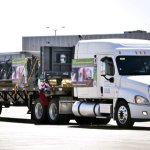
The rest of the story emerges about the El Paso times story we wrote about earlier this week, concerning the thousands of violations reported by Texas DPS inspectors at two commercial crossings in El Paso Texas.
While we have some concerns about the number of violations reported over 4.5 years, the Times story claims 1.2 million inspections were done at the Zaragosa and Bridge of the Americas in El Paso, we could only find 811,574 inspections reported on the FMCSA NAFTA STATISTICS pages.
Some have suggested that the numbers are flawed considering the man hours that would need to be expended to come up with this number of inspections in the time frame indicated. That’s possible but highly improbable considering the methods used and the manpower on site.
Section 350(c) required, among other things, state inspection/weigh stations be established at all commercial crossing along the southern border, to monitor and inspect incoming Mexican trucks, especially those participating in the 2007 cross border program. The defunding of that program by the Obama administration as political payback to the Teamsters, however, did not defund these inspection facilities. Contrary to what opponents of cross border trucking and Mexican trucks would have you believe, 100% of the trucks crossing our southern border are INSPECTED at these facilities. 350(c) mandates that these stations to be in operation during the hours the commercial crossing are open.
In El Paso, The Zaragosa bridge is open Monday – Friday 0600 to Midnight, or 18 hours. On Saturday, they are open from 0800 to 1600 and closed on Sunday.
The Bridge of the Americas hours of operation is Monday – Friday, 0600-1800 or 12 hours. Saturday hours are 0600-1400, closed on Sundays.
The hours the inspection stations where this data was supposedly gleaned from are required under law, to maintain the same schedule.
The Texas DPS commercial vehicle inspectors perform inspections under the CVSA North American Inspection Standards, although Texas being Texas, has been known to put additional, more stringent, some would say “anal” requirements to their inspections.
There are six levels of CVSA inspections, although Levels I-III are pertinent to this discussion.
The Texas DPS uses the California model of inspections. DPS troopers don’t actually do Level I inspections, either roadside or in the inspection facilities. This is left to state employees who are CVSA certified truck inspectors. Each trooper working a static inspection station has anywhere from 2 to 6 of these inspectors on the ground visually inspecting trucks as they cross the inspection area, pulling them aside at random or for cause for inspections, generally Level II, From personal observations of these operations, you’ll generally have 3 or 4 troopers manning these inspection facilities with 6 or more truck inspectors working the bays. This doesn’t take into consideration the participation of federal FMCSA inspectors, who appear at random to work alongside the state inspectors.
So with that manpower available, the number of inspections stated are entirely possible in the time frame indicated. A Level II takes no more than 15 minutes, unless violations are found.
Capt. Jessie Mendez, who oversees the border truck safety inspection program and inspectors for the Texas Department of Public Safety/Texas Highway Patrol stated;
“Taking trucks out of service means they were not allowed to proceed beyond the state inspection stations. They are not allowed to go onto the streets of El Paso.”
While the violations may seem severe, such as trucks sidelined for brakes that were out of adjustment, flat tires, defective stop lamps, improper axle position, improper torsion bar, damaged or leaking brake hoses, and air suspension pressure loss, others are ridiculous such as drivers being put out of service for driving without their prescription eyeglasses or carrying and extra pair, all arcane rules contained within FMCSA rules, but rarely enforced otherwise.
[pullquote]“The number of violations for the trucks from Mexico is in line with U.S. industry standards.They are either no worse than U.S. trucks and better in some cases.”- Rep. Joe Pickett, D-El Paso[/pullquote]
Texas though has special little quirks they write warnings for, which still show up on a carriers CSA/SMS matrix. For instance, a mudflap with a small tear in it will get you a violation. An air or electrical cord that shows evidence of having bounced off the deck plate is a violation. And the new favorite of the DPS, not having spare electrical fuses or breakers in your glove box.
So while the violations on their face may seem serious, in many times they’re the opposite, but warnings are given to justify requests for additional federal funding.
But the truth doesn’t matter to some of those opposed to Mexican trucks and Mexico in general, one of those being the irrelevant little man who for now, is President of the Teamsters Union, James P. Hoffa.
Hoffa, in his response to this article said;
“This report confirms what we have been saying for years – Mexican trucking companies and their fleets are not held to the same stringent safety standards as American carriers. Until they meet every safety, training and environmental standard that our trucking companies meet, we should not allow these unsafe Mexican trucks to drive freely through our country.”
As we said, Hoffa is a foolish, irrelevant little man whose opinion on this issue holds little weight, as evidence has proven his statement to be a totally false distortion of the facts.
But I did get a good chuckle reading the response from
TEAMSTERNATION, an anonymous blog maintained by who knows who.
The blogger states;
R-i-i-i-ight.
Unfortunately, Pickett is exhibiting the same cluelessness about the dangers of Mexican trucks as the U.S. Department of Transportation, which wants to open the borders to them in a month or two.
The Teamsters will see about that.
They refer of course to State Rep. Joe Pickett, D-El Paso, who said the number of violations for the trucks from Mexico is in line with U.S. industry standards. Rep. Pickett is absolutely correct in his assessment.
Pickett went on to state;
“They are either no worse than U.S. trucks or better in some cases,”
And people, remember this. These trucks that were inspected were entirely Mexican drayage rigs with OP-2MX authority to operate within the 25 mile commercial zone. These are the older trucks used by the Mexicans, the same as US owner operators who operate out of our ports and rail heads in the United States. These are not the new or late model trucks that are used to haul freight long haul within Mexico and soon within the United States. There is absolutely no similarities in one or the other.
Say it ain’t so people! James P. Hoffa and his Teamsters, and Todd Spencer with his minority of American truckers are aligning themselves with the left wing enviro-wackos in a last desperate attempt to stop fewer than 100 late model Mexican trucks from entering the country?
Politics and nativist protectionism make strange bedfellows sometimes as the latest press release from the Teamsters points out.
In comments submitted to the Department of Transportation (DOT), the International Brotherhood of Teamsters and the Sierra Club raised frivolous and baseless concerns with what they claim is the failure of the Federal Motor Carrier Safety Administration (FMCSA) to adequately assess the environmental impacts associated with the upcoming U.S.-Mexico cross-border trucking pilot program.
Hoffa erroneously claims:
“With this assessment, the FMSCA is recklessly ignoring the true environmental impact Mexican trucks will have if permitted to travel without restrictions throughout our country. We contend that the FMSCA has violated the National Environmental Policy Act by not addressing the full, cumulative effects on our environment prior to starting the cross-border pilot program.”
The “assessment” he is referring to is the announcement last month of the availability of a Draft Environmental Assessment (DEA) that evaluates the
potential environmental impacts resulting from the implementation of its United States-Mexico cross-border long- haul trucking pilot program in the FEDERAL REGISTER.
But Hoffa and his Teamsters as well as Spencer and OOIDA are blowing smoke up the asses of the American public and US truckers. They’re bringing up an issue that was resolved years ago by the Supreme Court of the United States.
It started back in 2002 when Public Citizen sued the FMCSA claiming an environmental impact study was required before any effort could be made to open the southern border to Mexican trucks as required under our NAFTA obligations.
At that time, FMCSA prepared an Environmental Assessment (EA), but they did not prepare and Environmental Impact Statement (EIS) as PUBLIC CITIZEN claimed was required by the National Environmental Protection Act (NEPA).
The EA focused mainly on the environmental impact from doing more inspections, not on the impact from more trucks driving the roads.
Public Citizen sued to stop the possibility of cross border trucking until an EIS was prepared.Public Citizen argued that the increased number of trucks on US roads was liable to have a significant environmental impact, and therefore an EIS was required. There claim was that more than 30,000 older polluting trucks burning high sulphur diesel would have an impact on our environment.
The trial court found in favor of the defendent, FMCSA. The Trial Court found that although the FMCSA pilot program would result in more trucks, FMCSA did not have control over those trucks and therefore did not have to account for them in an EIS. Public Citizen went shopping and appealed to the liberal Ninth Circuit Court of Appeals in San Francisco.
The Ninth Circuit ruled in favor of the plaintiffs, reversing the trial court. The Appellate Court found that the EA was deficient because it failed to give adequate consideration to the overall environmental impact from the Mexican trucks. Of course, FMCSA appealed, all the way to the United States Supreme Court.
The case was argued before the Supreme Court on April 21, 2004 with a unanimous verdict being rendered on June 7, 2004.
The US Supreme Court held that the FMCSA had no control of the trucks once the regulations governing the pilot program were passed, and would therefore be unable to act on the findings of an EIS even if it did conduct one.
FMCSA has no statutory authority to impose or enforce emissions controls or to establish environmental requirements unrelated to motor carrier safety.
The Court also found that the passage of the regulations was not sufficiently responsible for the increased pollution caused by the trucks to warrant an EIS.
Justice Clarence Thomas, the Courts most conservative Judge wrote the opinion which you can read here.
Now in their desperation to keep a handful of late model, closely monitored Mexican trucks from entering this country, they ally themselves with the tree huggers. They ignore the more than 30,000 Mexican rigs that access the United States daily, some with authority to run anywhere in the country they desire.
Take OOIDA for instance. They’re always preaching against more government regulations and fighting CARB, the California Air Resources Board, which has some of the most stringent environmental rules in the country (and rules that Mexican trucks follow daily). A good example of that is OOIDA’s statement in opposition to new fuel economy rules for big trucks.
OOIDA says;
The Owner-Operator Independent Drivers Association (OOIDA) called the administration’s announcement today for greenhouse gas emissions standards for heavy-duty trucks a flawed, one-size-fits-all rule. The new rule ignores input from small-business trucking, overlooks less expensive options to achieve EPA goals of reduced emissions, and will ultimately increase new truck costs.
The Environmental Protection Agency (EPA) announced a first-ever rulemaking for new large tractor-trailer trucks that requires trucks to achieve up to approximately 20 percent reduction in fuel consumption and greenhouse gas emissions by model year 2018.
“By totally ignoring the impact on small-business trucking, the EPA has demonstrated yet another example of our wretchedly broken regulatory process,” said Joe Rajkovacz, Director of Regulatory Affairs for OOIDA. “Congress should take action when they return in September to rein in the bureaucracy and push forward regulatory reform legislation that has already been introduced.”
Notice the hypocrisy and desperation? They oppose the new mileage standards and are demanding the Administration to stand down from all the excessive regulations they’re putting on us, a position I totally agree with, yet in the next breath, they demand more regulations against a few Mexican trucks.
In an article published on August 12, 2011 titled FMCSA’s environmental assessment of cross-border program falls short, OOIDA claims,
Currently, Mexican emission standards for diesel-powered truck engines are only aligned with U.S. EPA emissions standards for six criteria pollutants through the 2003 model year. This means that newer engines for Mexican trucks need not comply with the more stringent U.S. emissions standards that came into play in 2004 through 2010.
The comments point out that since Mexico has not aligned its diesel engine emissions standards to U.S. EPA 2004 standards, the differences can be stark – as much as 20 times the nitrogen oxides and 10 times the particulate matter, based on using diesel with a sulfur content of 500 parts per million.
The ability to add additional fuel tanks makes it possible for trucks from Mexico to fill up with the low-sulfur diesel available in Mexico and never have to fuel up while in the states – polluting at a higher level than corresponding U.S. trucks.
OOIDA’s comments propose two options to FMCSA to ensure a minimal environmental impact the cross-border program may have.
The first, would be to only allow trucks that meet U.S. EPA model year emissions standards for the year in which the engine was manufactured. We don’t have a problem with that and indeed, that is stated in the proposal for the new cross border program. Guess that part went over their heads at OOIDA.
The second is ridiculous and nothing in the section of NAFTA regulating cross border trucking, nor int he arbitration panel ruling requires this. OOIDA’s idea would force trucks arriving from Mexico either to have ULSD fuel purchased in Mexico on board or to have possibly to one-fourth tank or less of fuel not meeting the U.S. ULSD standard – so they could purchase compliant fuel once crossing the border.
Even if Mexican trucks were using diesel fuel consisting of 5000 ppm of sulfur, the environmental impact of less than 100 trucks would be absolute zero.
This is simply another method by the opponents to throw up more roadblocks to our compliance with our international obligations. Fortunately, they’ll lose this fight too.
Mexican truckers such as these are covered under Mexican Labor Law which dictates HOS, benefits, employee rights etc. Photo- Guillermo Arias/Associated Press
Much of the misinformation coming from opponents of cross border trucking with Mexico seems to be coming from ignorance of the country rather than deliberate attempts to misinform the public, I’d like to think, at least where the regulatory structure in Mexico is concerned.
Two of those issues that have been forcibly pushed on the public is lack of Hours of Service Regulations in Mexico and what some perceive as a “weak” or non existent regulations for the Mexican trucking industry. Regulations of the trucking industry in Mexico is neither of those.
The differences are enormous as trucking journalist Tim Brady points out in his article REGULATING TRUCKERS.
Brady writes;
Mexican Truckers’ regulations are consequence regulations. If a Mexican trucker makes a mistake–consequences: the Mexican government will take away his ability to operate a commercial vehicle for a period of time. If he causes an injury in a preventable accident–he will lose that privilege for the rest of his life; if there is a fatality–the trucker goes to jail for years. Mexican truckers are required to have work visas to drive in the US; the cost and time it takes to get one in itself becomes a deterrent for being unsafe.
In contrast, the U.S. babysits its truckers and attempts to micromanage every 15 minutes of a trucker’s life through the Hours of Service, EOBRS etc. It is a different view of how to manage the safety of truckers.
MEXICAN LABOR LAW AS IT APPLIES TO THE MEXICAN TRUCKER
Unlike in the United States, Mexican employee rights are constitutionally guaranteed. Mexican labor law has its foundation in Article 123 of the Mexican Constitution, and is implemented through a number of Federal laws, including, the Federal Labor Law (Ley Federal del Trabajo), the law regulating the National Housing Fund for Workers (Ley del Instituto del Fondo Nacional de la Vivienda para los Trabajadores), the Social Security Law (Ley del Seguro Social) and others. The Federal Labor Law, was first adopted in 1931, and amended in 1970.
For those interested, the Labor Laws of Mexico can be downloaded HERE. Rules specific to the Mexican trucking industry are found in Chapter 6 on page 50 titled “Trabajo de Autotransportes”.
Let’s take a look at the law that covers the commercial driver in Mexico.
Article 256 .- The relationship between truck drivers, drivers, operators, collectors and other workers serving trucking board public service of passenger, cargo or mixed, or urban outsiders, such as buses, trucks or cars, and owners or licensees of the vehicles are working relationships and are subject to the provisions of this chapter.
The stipulation in any way misrepresented the provisions above, produces no
legal effect, nor prevent the exercise of rights arising from services rendered.
Article 257 .- The salary is fixed per day, per trip or by ticket sales or by circuit or kilometers routes and will consist of a fixed amount, or a premium income or the amount that exceeds
a given income or in two or more of these forms, under no circumstances be less than the minimum wage.
When the salary is fixed per trip, workers are entitled to a proportionate increase in case
to extend or delay the normal term of the journey because they do not attributable.
Wages can not be reduced by shortening the journey, whatever the cause.
In urban transport or circuit, (intercity bus drivers) workers are entitled to be paid the salary in the case of service interruption due to causes beyond their control. It violates the principle of equal pay provision stipulating the different wages for equal work, if it is provided in lines or services of different categories.
Article 258 .- In determining the salary of days off will be increased to perceive the
work in the week, with a sixteen hundred sixty-six.
Article 259 .- In determining the amount of the salary of holidays and
compensation are subject to the provisions in the second paragraph of Article 89.
Article 260 .- The owner of the vehicle and the licensee or permit holder are jointly
responsible for the obligations arising from labor relations and law.
Article 261 .- It is forbidden to workers:
I. The use of alcoholic beverages during the service and the twelve hours before
beginning work;
II. Use narcotics narcotics or drugs in or outside their working hours without a doctors prescription. Before starting the service, the employee must bring the matter to the attention of the employer andpresent the prescription signed by the physician, and,
III. Receive freight or passage out of the places mentioned by the company for such purposes.
Article 262 .- The workers have special obligations as follows:
I. Treat them with courtesy and dedication passage and cargo with caution;
II. Undergo periodic medical examinations prescribed by law and other rules
work;
III. Caring for the proper functioning of the vehicles and inform the employer of any faults observed;
IV. Make the journey emergency repairs to enable their knowledge,
tool and parts available to them. If you can not make repairs, but the vehicle
can continue to run, drive to the nearest village or to the place fixed for
repair, and
V. Observe traffic regulations and the technical specifications prescribed by national authorities or the employer.
Article 263 .- The employer has the following specific duties:
I. In the long haul transport, will pay for accommodation and meals for workers
when trip is prolonged or delayed for reasons that is not attributable to them;
II. Make repairs to ensure the smooth operation of the vehicle and the safety of
workers, consumers and the general public;
III. Provide vehicles and spare parts essential tool for repairs
emergency and
VI. Observe all traffic regulations on operating conditions and
vehicle safety.
Article 264 .- The special causes of termination of employment relations:
I. Refusal to make the trip contract or its termination without cause. be considered
in any case cause the fact that the vehicle meets the safety
essential to safeguard the lives of workers, users and the public in general;
II. And reiterated the significant decrease of revenues, unless circumstances
justified.
Amazing isn’t it? In the United States, we are considered unskilled labor by the US Department of Labor, and have no specific protections other than those spelled out under OSHA, and various employment laws, which in most cases provide protection for the employer rather than the employee. So let’s recap what we’ve learned.
- ARTICLE 256 establishes the purpose of the chapter and those who are covered by this segment of the law.
- ARTICLE 257 establishes how the driver is paid and restricts deductions, protects pay in event something occurs beyond the control of the driver.
- ARTICLE 258 establishes the salary and the work week which we’ll discuss further in this article
- ARTICLE 259 establishes the salary to be paid for holidays and weekends as we’ll discuss later
- ARTICLE 260 establishes that the owner or license holder of the vehicle is responsible for compliance with the applicable provisions of this law
- ARTICLE 261 Prohibits workers from (1) using alcohol during working hours or for 12 hours prior to reporting for duty, similar to the US rules from FMCSA, (2) Prohibits the driver from using drugs inside or outside of work unless prescribed by a physician, again, similar to US FMCSA rules. and (3) prohibits drivers from accepting hauling freight or passengers outside of their normal duties, ie: bootleg freight or contraband.
- ARTICLE 262 establishes the workers obligations to their jobs and to their employer. Notice how these codified requirements meet or exceed the regulatory standards under FMCSA rules. (1) Courtesy towards their passengers and care for their cargo as applicable. (2) Submit to medical examinations as required by their employers, Federal Police for cause and to obtain their Mexican CDL under the rules of the SCT (Secretariat of Communications and Transport), (3) Pre-trip inspections of their vehicles and reporting of problems found to their employers. (4) Make emergency repairs to their vehicle with parts and tools available, and if not able to do so, and the vehicle can safely make it, take it to the nearest place for repairs. (5) Observe all traffic regulations, State, Federal and Municipal and follow all orders of the employer.
- ARTICLE 263 codifies the responsibility of the employer towards the employer. (1) The employer is required by law to pay for the truckers hotel and provide a per diem for the driver when out overnight. (2) Keep the vehicle in safe and compliant working order to protect the employee and the general public. (3) Provide repair services to keep the vehicles road worthy. (4) Compliance with all applicable Federal, State and Municipal regulations. In other words, cannot force or require the worker to break the law.
- ARTICLE 264 establishes the reasons an employer can terminate an employee for cause. Remember, in the US, unless you’re union, you work at the pleasure of your employer and can be terminated for any reason or no reason. (1) Refusal to accept a trip assignment, abandoning a truck or load before delivery if the vehicle is safe and complies with all applicable rules, laws and regulations. (2) Who the hell knows what that means
So there you have it peeps. A law that protects the employer and the employee, lays out the responsibility of both parties and gives the Mexican trucker rights that we don’t have in this country, or if we have them, are routinely abused by our employers.
But it is not all as cut and dried as it might seem. Mexico’s labor law also provides other instances which an employee, any employee in any industry can be terminated for cause. All of this is codified as law.
An employer may terminate an employee’s employment without liability only upon completion of the project,
upon expiration of the specified term of employment, or for cause as defined in Article 47 of the Federal Labor Law.
Article 47 lists 15 causes for termination:
- the employee provides false references regarding her abilities, skills and qualifications for the job;
- the employee is found guilty in the course of her employment of a dishonest or dishonorable action, violence, threats or ill-treatment towards the employer or any member of the employer’s family or top management or managerial personnel of the work place, except in cases of provocation or self defense.
- the employee is guilty of any acts mentioned in the proceeding items towards any co-workers
- the employee is guilty, outside of the work place, of any acts mentioned in item 2 above towards the employer, any member of the employer’s family or the top management or managerial personnel, in the said acts are of such a serious nature as to render the fulfillment of the labor contract impossible;
- the employee intentionally causes material damage to the buildings, machinery, tools, raw materials or other items in work place
- the employee causes damage of a serious nature, acting without malicious intent, but with negligence which is the sole cause of the damage
- the employee negligently or carelessly endangers the safety of the work place or persons therein
- the employee is guilty of immoral conduct in the work place;
- the employee reveals trade secrets or communicates matters of a private or proprietary nature to the determent of the business;
- the employee is absent for more than three times in a period of thirty days without the employer’s permission or without sufficient excuse
- the employee refuses to obey the employer or her representatives without sufficient reason in matters connected with the services the employee has agreed to provide
- the employee refuses to adopt preventive measures to follow the procedures put in force for prevention of accidents or disease
- the employee attends work intoxicated or under the influence of a narcotic or harmful drug, unless she has a medical prescription, in which case, she must inform the employer of her prescription and submit a certificate signed by a doctor;
- an executory judgment sentencing the employee to a term of imprisonment preventing her from fulfilling her obligations under the labor relationship is issued
- other grounds similar to those specified in the preceding paragraphs, if such grounds are of equal gravity and entail similar consequences.
In the event of termination for cause, the employer must give written notice to the employee of the date of the termination of her contract and the reasons for termination. Failure to provide written notice of the reasons for termination shall be sufficient grounds to consider that the termination was not justified.
So even in the event of termination for cause in Mexico, both parties rights are protected, if the law is followed. But let’s say a trucker in Mexico is fired because his employer is having a bad day or for some of the reasons we get fired in the US, in other words, unjustified termination. If a US driver is fired, what rights does he have and what recourse against the employer? None that I am aware of. We serve at the pleasure of our employers.
However, in Mexico, ah, Mexico, that third world country to our south, with no rules or regulations, provides relief for the employee who thinks he has been wrongfully terminated and the onus of proof is on the employer.
Mexico has a Conciliation and Arbitration Board, which is an administrative agency charged with resolving labor disputes. An employee may file a complaint with the Conciliation and Arbitration Board demanding reinstatement or damages within two months of their discharge. The employer has the burden of proving that the employee was terminated for cause pursuant to Article 47 of the Federal labor law. If the employer fails to meets its burden of proof, the Conciliation and Arbitration Board may determine the termination was without justification and award appropriate relief to the wronged employee.
In the event that the Conciliation and Arbitration Board determines that the employer terminated the employee without justification, the employee has the right pursuant to Article 48 of the
Federal Labor Code to:
- Reinstatement of her job; or
- Compensation in the form of three months’ wages based upon integrated compensation (i.e., as discussed above, all compensation, including benefits, that the employee can prove she received from the employer during the previous 2 years.
Article 49 of the Federal Labor Law provides that employers are not obligated to reinstate an employee, and the employee may not seek reinstatement, in cases in which: (1) the employee has not been employed with the business for at least one year; (2) the employee is an executive employee; (3) the reinstatement, given all of the circumstances, would be impossible; (4) if the employee rendered domestic services; or (5) if the employee worked part time.
Article 49 requires that if the employee requests reinstatement and is entitled to reinstatement, but the employer refuses to reinstate, then, in addition to the three months’ compensation described in (b) above, the employer must also pay the indemnifications spelled out in Article 50 of the Federal Labor Law as follows:
- An amount equal to the total integrated compensation payable for one-half of the entire employment period if the employment was for less than one year, or an amount equal to six months’ integrated compensation for the first year of service, plus twenty days’ wages for each additional year of service;
- If the term of employment was indeterminate, then the compensation shall be twenty days’ wages for each year of service; Furthermore, in any event, the employer shall also pay the entire amount of integrated compensation due to the employee from the date of dismissal to the date on which the compensation is paid.
Finally, Article 162 of the Federal Labor Law mandates that the employer still has to pay a worker dismissed with or without cause, as well as an employee who resigns with fifteen years or more seniority, a seniority premium equal to twelve days’ salary for each year of service rendered. The seniority premium may not, however, be greater than two times the minimum salary then in effect in the economic zone where the employer is located.
MEXICAN TRUCKERS PAY IN MEXICO NOT WHAT YOU THINK
Another objection to the Mexican trucks in the US, is that Mexican truckers are not paid at a rate, equal to a US driver. Well, neither or the Canadians. However, in Mexico, driving a truck is a skilled profession and the truckers are well regarded by the populace. With weekly pay or salary in Mexico averaging $150.00 for a 46 hour week, a Mexican trucker earning $.15cpm and driving 2500 miles a week is earning a salary well above average. But in addition to basic wages, Mexican labor law, again codified thus requiring compliance by the employer.
Social Security (IMSS). Employers must register employees with the Mexican Institute of Social Security (IMSS) within five days of their hire date. Employers must contribute a minimum of 17.42 percent of each worker’s salary, depending on the risk-factor of the job, into the social security fund. Employees and their dependents are entitled to IMSS benefits, including the following:
- Retirement Benefits. Retirement is at age 60, with at least 1,250 weekly contributions. The benefit is calculated based upon a multiple of the minimum wage.
- Survivor Benefits. Employees must purchase a life annuity with survivor benefits from a private insurance carrier using funds in their pension accounts.
- Disability Pension. Employees must purchase an annuity with survivor’s benefits from funds in their pension accounts.
- Medical Coverage. Mexican employees may use IMSS medical facilities for essentially all of their health care needs. The benefits provide coverage for a period of 52 weeks, which may be extended if the employee is still contributing to the plan.
- Sickness Compensation. Employees are entitled to 100% of their earnings for up to 72 weeks. After 72 weeks, disability benefits take effect.
- Maternity. Pregnant employees are entitled to 100% of their weekly wages for up to 6 weeks before and 6 weeks after delivery.
- Funeral Grants. Eligible employees are entitled to a payment equal to up to 2 months of minimum wage.
- Day Care. Eligible employees are entitled to have their children ages 43 days to 4 years cared in day care facilities free of charge to the employee.
- Retirement Fund (SAR). Employers must contribute 2% of up to 25 times the annual minimum wage into the retirement fund. Employees may, but are not required to, contribute to the fund. The benefit is payable upon the employee’s death, disability, or reaching retirement age. The benefits are paid out for a maximum of 20 years.
- Workers’ Housing Fund (INFONAVIT). Employers must contribute 5% of the employee’s earnings to the Workers’ Housing Fund. The funds are then placed into individual employee accounts to be used as a source of money for the employee to purchase a house, or as a source for low interest loans for the same purpose. If not used, the funds are paid to the employee uponr etirement, death or disability.
Additional benefits mandated by law include:
- Christmas Bonus (Aguinaldo). Employers must pay employees who have been in their service for at least one year, a year end bonus equal to at least 15 days’ wages before December 20th of
each year. By practice, the aguinaldo may be equal to 20 or 30 days wages. Employees who have worked for less than one year are entitled to a pro-rated aguinaldo equal to the portion of the year during which they have worked.
- Vacation Premium. Employers must pay a vacation premium to employees equal to 25% of the wages payable during the vacation period.
- Vacation. Employees employed for more than one year are entitled to at least 6 days paid vacation. Vacation leave is increased 2 days for each additional year up to a maximum of 12 days. Additionally, for every 5 years of service, 2 additional days must be added
- Legal Holidays. Mexico has 7 paid legal holidays including: January 1 (New Year’s Day), February 5 (Constitution Day), March 21 (Benito Juarez Day), May 1 (Labor Day), September 16
(Independence Day), November 20 (Revolution Day), December 25 (Christmas). In addition to those already mentioned, every 6th year when a new president is sworn into office, employees receive
a paid day off on December 1 (Inauguration Day).
- Profit Sharing. After the first year of business (there is an exemption for the first year of business), employers must pay employees an amount equal to 10 percent of the profits of the
employer. This amount is to be paid annually. Certain executive and confidential/trust employees are not entitled to the profit sharing.
Can you believe it? Retirement benefits mandated by law and with no involvement of a labor union. Maternity benefits? Remember how big business fought against that in the US and now that we have it, a woman can take maternity leave, but with no compensation.
Free healthcare? I use the IMSS clinics at times, although I have to pay and they provide excellent services and care.
Vacation pay? Profit sharing?
Could it be, that Mexico, who everyone considers to be a third world country, is actually ahead of the curve, and perhaps it is the US that needs to catch up?
HOURS OF SERVICE IN MEXICO
One of the strongest objections opponents of cross border trucking have made is that Mexico has no hours of service regulation to control the hours their truckers operate. In the United States, HOS rules are established by the rulemaking process within FMCSA. In Mexico, Hours of Service rules for truckers are established by Constitutional mandate.
But the mandate is not specific to truckers, but to all workers, as shown above. Hours of Service for truckers are set under Mexico’s Labor Laws, not the SCT, Mexico’s equivalent to the FMCSA.
Mexican labor law establishes the Work week, work day and other factors, which apply to the trucking industry as all other segments of the labor population.
The Work Week. The federal Labor Law of Mexico sets forth a maximum of 48 hours per week as the amount of hours a laborer can work without going overtime. Even so, most companies only run the work week at 40 to 45 hours
The Work Day. For every 6 days of work ( Monday through Saturday ), employees are entitled to one day of rest with full pay. In other words, you are working 6 days but being paid for 7, under the law.
Work Shifts. There are 3 work shifts, consisting of the day shift ( eight hours ), the night shift ( seven hours ) and the mixed shift ( 7 1/2 hours ). The mixed shift is part day shift and part night shift. Those hours that are worked over these periods are considered to be overtime ( paid as such – double the hourly rate ) and can not go over 9 hours per week. THIS IS THE PROVISION THAT ALSO COVERS MEXICO’S COMMERCIAL DRIVERS AND THUS IS A DEFACTO HOS LAW.
Upper Left: Mobil Medical Unit – Upper Right: Initial Exam – Lower Left – Part of Medical exam for LFC qualifications – Lower Right – Application line at Federal Testing Center
In a draft submitted to the Motor Carrier Safety Advisory Committee in September of 2010, a committee which Todd Spencer, Executive vice president of OOIDA is a member and surely has seen this memo, The SCT of Mexico shared a review of Mexican fatigued drivers. The SCT found:
- Only 38% drive between 5 and 8 hours a day
- 62% drive more than 9 hours a day
- 42% and 45% of passenger bus and truck drivers drive 9-12 hours a day and 0.7% are involved in fatal accidents
Results of the study show that 38% drive well below time mandated by Mexican labor laws. The 62% that drive more than 9 hours a day are not violating the law, but are also receiving double time for their work. The third line show us that their work days are pretty much in compliance with US HOS rules and Canadian rules which allow 13 hours a day of driving, compared to our 11 hours a day.
So far those who say Mexico has no drug testing, no way to check a drivers license history, the above SCT reports can prove differently.
For those who continue to claim Mexico has no HOS mandated, the Labor Laws of Mexico prove different.
And for those who claim the pay disparity between a Mexican driver and a US trucker will result in an unfair advantage to the Mexicans, consider all the benefits, mandated by Mexican law that the employer has to pay the Mexican trucker to be in compliance. It adds considerably to the cost to the employer and is a factual benefit to the employee.
I’ll close this with a modified quote from the esteemed trucking journalist Tim Brady from his article referenced above:
the side of the trucking industry who believe every trucker is an irresponsible adolescent who needs to be baby-sat every hour and mile they drive. And the side that’s drunk the Kool-Aid that says just because a country doesn’t regulate their truckers in the same micro-management manner the US does, they must be unsafe and dangerous. This lacks logic and common sense. Anyone knows the more you try and control any segment of the population, the more you will either dumb down the quality of those individuals – or they will revolt.
Perhaps there should be some revolt against those who have engaged in a deliberate campaign to smear the Mexican trucking industry and instill irrational fear into their members on a subject they no nothing about to satisfy their own self interests.
Only .08% or 35 miles of our 4000 mile border with Canada is secure, which can allow unknown amounts of drugs, terrorists and who knows what else to cross undetected, but this is not of concern to opponents of cross border trucking with Mexico. Can't offend our white, English speaking friends to the north now can we?
Mark Reddig is on the radio exhorting his listeners that the Cross Border Pilot Program with Mexico will “destroy” the US trucking industry.
The August issue of OOIDA’s in house rag, LAND LINE is being pimped on the same program with emphasis on their headline story DOT’s DOG & PONY SHOW, an article where they showcase their “expertise” on the southern border from their ivory tower in Grain Valley Missouri, 1000 miles from the source of their concern.
OOIDA has long been using the illogical argument that Mexican trucks should be banned from the US because they “might” bring drugs, illegals, WMD’s and terrorists into this country. Hogwash! Yet they gloss over and largely ignore a recently released report from Canada’s Royal Canadian Mounted Police Intelligence Division showing that the problem is not restricted to the southern border exclusively.
From THETYEE.CA:
The trucking industry employs over 400,000 people in Canada, and the average fulltime driver earns $858 a week. The industry is dominated by small for-hire carriers and independent owner/operators whose main role is to haul freight for others.
These drivers are most vulnerable, because they are striving for economic viability due to the recession, more competition, and stricter new security and environmental rules. “This is an enriched opportunity for organized crime to offer financial incentives to supplement flagging incomes,” the report notes. The industry was also hit hard by skyrocketing gas prices last year.
The report also warns of a middleman broker who serves as the key link between criminal groups and truck drivers. This person is a specialist who recruits, pays, and sometimes terrorizes truckers into carrying illicit drugs, cash, and illegal migrants.
Money spent to transport illicit cargo is a small cost of doing business for criminal groups, but is a “significant incentive” for drivers. For example, a trucker can be paid $28,000 to move $12 million worth of cocaine from California to Montreal.
Besides cocaine and cash, the cargo can include illicit tobacco, marihuana, ephedrine, and Ecstasy, which are often packed in increasingly sophisticated compartments built into tractor trailers. Moving large amounts of cash may be the criminals’ peak of success, showing a high level of trust and elevated status. (Cocaine is the illicit product most often caught entering Canada at the border, while marijuana is the drug most often trucked within the country.)
Loads are often guaranteed, sometimes with money provided up front by the transporters. The trucker criminal “specialists” are held responsible for illicit cargo that has been lost, stolen or seized, often resulting in a nightmarish cost.
“For illicit cargo that is missing, the transporter is expected to provide compensation or risk harsh consequences, including extortion and violence,” the report says. “Violence associated to lost cargo includes beatings, kidnapping, and murder.
“Discipline is usually meted out from within the transportation group at the behest of the larger criminal organization or to deal with internal disputes. Loads stolen or seized from drivers provide leverage for further exploitation by crime groups, often resulting in an indentured arrangement in which the driver is drawn further into the criminal activity and required to move illicit commodities at no cost, to fulfill the debt.”
The ease by which trucking companies can be formed makes the industry especially attractive, which leads to a continued proliferation of “illicit trucking companies.” Criminal groups conceal their illicit activities through layers of company ownerships, name changes, transfers and disclosures.
They benefit from fragmented regulatory oversight, which is so complex that it is difficult for police to track at what point in the chain the criminal activity occurs. “Organized crime groups own and operate trucking companies in relative autonomy, without close government or industry scrutiny,” and all these factors give them a “considerable advantage” over the police.
Trucking crime occurs in every region. Three quarters of truck traffic that crosses the Canada-U.S. border pass through Ontario and Quebec, which have about 31,500 owner/operators. Most of the criminal groups the RCMP examined have companies based in Brampton and Mississauga.
Although British Columbia and Yukon (with 7,400 owner/operators) accounts for just 10 per cent of the cross-border truck traffic, B.C. is a major source for marijuana growing and export, and cocaine enters B.C. in multi-million dollar amounts.
More interdictions of commercial trucks means a short term inconvenience for criminals, forcing their shift to other modes, such as aircraft, boat, or the movement of more frequent and smaller loads. Doing so in private vehicles and rentals will increase the importance of warehousing.
Moreover, since smaller companies are finding cross-border trade less affordable (which some experts say might even challenge their ability to stay in business), criminal specialists may find ways to infiltrate and compromise larger trucking companies, in order to keep transporting their cargo abroad.
So again, where’s the outrage from OOIDA and other opponents of Cross Border Trucking? Where’s the demand to close the northern border to the drugs and who knows what else crossing the largely unsecured northern border?
In February, Sens. Joe Lieberman and Susan Collins, the two top senators on the Homeland Security and Governmental Affairs Committee stated;
“The Department of Homeland Security has concluded that the risk of terrorist activity across our northern border is actually higher than across our southern border. The DHS could do a better job of border defense. The report also finds that less than 1 percent of the border is under operational control – less than 1 percent of our northern border.”
Sen. Joe Lieberman, Connecticut independent and committee chairman, said that the lack of a strong defense along the northern border is “absolutely alarming” and that it leaves the American public “grossly underprotected” from terrorist attacks, drug smugglers and other illegal activity.
Again, where’s the outrage and demands to close the northern border and send the Canadian trucks back to Canada?
The Canadian trucking industry moves more than 70 per cent of goods into Canada from the United States and employs 400,000 people. Almost three-quarters of the cross-border traffic passes through points in Ontario and Quebec, which have close to 31,500 owner-operators, according to the report. This is far more than the 1,065 “certificated” or “legacy” carriers from Mexico, grandfathered in after the 1982 foreign carrier exclusion order was signed and significantly more than the approximately 25,000 Mexican trucks with OP-2 authority that operate exclusively within our commercial zones on the southern border.
MOVING CONTRABAND ACROSS THE SOUTHERN BORDER
OOIDA and others claim that the majority of contraband smuggled across the southern border comes by truck. Simply not true, as any CBP or Border Patrol official will tell you.
You see trucks impounded at the interior BP checkpoints, all of them US trucks driven by US truckers. Indeed, the RCMP report states truckers contracted to run a load of cocaine from California to Montreal enjoy a payday of $28,000 or more. The criminal organizations don’t need threats to find truckers willing to take the risk for a payday like that. Nor do they have any problem finding truckers running off the southern border looking for a little easy money, without considering the risks involved.
A good example of this can be found by reading the Border Patrols weekly blotters.
U.S. Border Patrol Weekly Blotter (07/27/2011)
- San Diego Sector – Border Patrol agents seized 35.5 pounds of methamphetamine, a Chrysler sedan, and arrested a United States Citizen (USC) at the traffic checkpoint near Pine Valley, California.
- Marfa Sector – Border Patrol agents seized a small amount of marijuana, a Cadillac sedan, a .38 caliber pistol, a .22 caliber rifle, 580 rounds of ammunition, and arrested two USCs at the traffic checkpoint near Sierra Blanca, Texas. Records checks revealed the handgun was reported stolen.
- Rio Grande Valley Sector – Border Patrol agents seized 1,093 pounds of marijuana and a Chevrolet Suburban near Los Ebanos, Texas.
- Rio Grande Valley Sector – Border Patrol agents seized 3,762 pounds of marijuana, a tractor-trailer, and arrested a USC at the traffic checkpoint near Falfurrias, Texas. A Border Patrol canine alerted to the trailer and a subsequent search by agents uncovered the marijuana.
- Rio Grande Valley Sector – Border Patrol agents seized a cargo truck and arrested a USC and 12 illegal aliens from Mexico at the traffic checkpoint near Falfurrias, Texas. A Border Patrol canine alerted to the vehicle and a subsequent search by agents uncovered the illegal aliens.
- Laredo Sector – Border Patrol agents arrested two nationals of Mexico, seven illegal aliens and seized a tractor-trailer at the traffic checkpoint near Laredo, Texas. The nationals of Mexico presented themselves for inspection and a Border Patrol canine alerted to the vehicle. A subsequent search by agents uncovered the illegal aliens concealed within the tractor.
- Laredo Sector – Border Patrol agents seized 1,373 pounds of marijuana and a Ford truck near Laredo, Texas.
- Rio Grande Valley Sector – Border Patrol agents seized 11,803 pounds of marijuana, a tractor-trailer, and arrested a USC at the traffic checkpoint near Falfurrias, Texas.
Only one instance of a Mexican national smuggling illegals, and those two will serve their time and be deported permanently with their visas revoked for life.
A “USC” is a United States Citizen for purposes of clarification.
And if that wasn’t enough to convince you consider the incidents CBP was involved in on one weekend in the San Diego Sector.
- At about 3:15 a.m. on Friday, July 22, a 37-year-old male Mexican citizen driving a blue 1988 Mitsubishi pickup truck arrived at the San Ysidro port of entry. The CBP officer referred the vehicle and driver for a more intensive screening; CBP officers screened the vehicle with an imaging device, similar to an x-ray, and detected anomalies with the pickup. CBP officers examined the vehicle and found 64 packages of marijuana, weighing a total of about 106 pounds, hidden in the sides of the truck bed, in the tail gate, and in the vehicle quarter panels.
- At about 6:00 a.m. Friday, July 22, a 42-year-old male Mexican citizen drove a gray 1994 Ford Aerostar to the San Ysidro port of entry. The CBP officer referred the driver and vehicle for an intensive inspection. A CBP officer with a narcotic detector dog screened the vehicle, and the canine alerted. CBP officers found eight packages of marijuana, weighing a total of eight pounds, hidden on top of the spare tire, which was suspended in its normal location under the vehicle.
- At about 3 p.m. on Friday, July 22, a 28-year-old male U.S. citizen driving a 1996 Ford Explorer arrived at the San Ysidro port of entry. While the driver was waiting in the lanes of traffic to approach the inspection booth, a CBP officer with a narcotic detector dog screened the vehicle, and the canine alerted. CBP officers inspected the vehicle and found 19 packages of methamphetamine hidden under the floor of the vehicle, weighing about 27 pounds.
- At about 3:15 p.m. on Friday, July 22, a 19-year-old female U.S. citizen driving a 1994 Nissan Maxima arrived at the San Ysidro border crossing. While the driver was talking with the CBP officer during her inspection, a CBP officer with a narcotic detector dog screened the vehicle, and the canine alerted. Upon conducting a further inspection, CBP officers found eight packages of marijuana, weighing almost 13 pounds, hidden inside the vehicle’s dashboard.
- At about 5:30 p.m. on Friday, July 25, a 28-year-old female U.S. citizen driving a silver 2001 Mitsubishi Montero arrived at the San Ysidro port of entry. The CBP officer referred the vehicle and driver for a more intensive screening, and CBP officers screened the vehicle with an imaging device, similar to an x-ray, and detected anomalies in the spare tire. A CBP officer with a narcotic detector dog also screened the vehicle, and the canine alerted. CBP officer removed 17 packages of marijuana, weighing a total of almost 85 pounds, from the spare tire.
- At about 9:30 p.m. on Friday, July 22, a 22-year-old male U.S. citizen driving a silver 1999 Dodge Intrepid arrived at the San Ysidro port of entry. While the driver was waiting in the lanes of traffic to approach the inspection booth, a CBP officer with a narcotic detector dog screened the vehicle, and the canine alerted. CBP officers screened the vehicle with an imaging device, similar to an x-ray, and noticed anomalies behind the back seat of the vehicle. CBP officers removed the vehicle’s back seat and discovered a compartment with 14 packages of marijuana, weighing about 37 pounds total, hidden inside.
- At about 5 p.m. Sunday, July 24, a 44-year-old male U.S. citizen driving a 2004 Chevy Silverado arrived at the border crossing in downtown Calexico. The CBP officer noted that the driver appeared nervous, and when inspecting the vehicle, tapped the gas tank and found it to be suspicious. CBP officers examined the vehicle further, including screening the vehicle with a narcotic detector dog, which alerted to the vehicle. CBP officers discovered 69 vacuum-sealed packages of marijuana hidden in the gas tank, weighing a total of about 155 pounds.
Now to be fair to OOIDA, the did make
“mention” of the RCMP report, spinning it to their liking, especially where the FAST (Free & Secure Trade) card is concerned. FAST, C-TPAT nor any of the other customs programs such as ACE, “speed” anyone through entry inspection procedures. They merely streamline the procedures by offering assurances that the person presenting the documents are in fact that person, negating the need, generally, for more intense inspection of identification.
But again, where’s the outrage from OOIDA over our non secure northern border and the outcry to call your Congressmen, flood the switchboards in DC and demand the Canadians be ejected and the border sealed?
Ahh, the hypocrisy! The MP’s in Ottawa, their allies at OBAC and others would never stand for it. If anyone recalls when the Western Hemisphere Travel Initiative was implemented in 2007, Canada immediately whined and protested to Washington resulting in Canadian residents being given a waiver of sorts. In place of a passport, an enhanced drivers license is all that is needed for most Canadians to enter this country. And nobody considers all of the “New Canadians”, the name given to Canadian immigrants, many from middle eastern Muslim countries who have flocked to Canada in recent years, and have the same free access to the United States as other Canadian citizens. As I recall, wasn’t it Muslims that attacked the United States on September 11? I don’t think they came from Mexico although quite a number of Mexican citizens lost their lives in the attacks on the twin towers?
Again, where’s the outrage instead of the hypocrisy?
You can READ & DOWNLOAD the RCMP here.
Absent any proof that allowing a few more Mexican trucks access to the United State under the upcoming Cross Border Pilot Program, will encourage more smuggling of contraband or worse, opponents of the pilot program, their allies and spokesmen on trucking talk radio are making an all out effort to fabricate a problem that does not exist, and enlisting acknowledged hate groups with ties to white supremacists, and convicted child murderers to to further spread fear and misinformation about Mexican trucks.
There have been posts by OOIDA members on hate sites such as STORMFRONT.ORG which have titillated and agitated the wannabe “turd reichers”, but not much has come of it. But on July 8, two days after resolution of the impasse on cross border trucking with Mexico was reached, that all changed.
On that day the Federation for American Immigration Reform, known by it’s acronym FAIR, released a statement that closely mirrors Teamster President James Hoffa’s ludicrous and debunked charges about unsafe and dangerous Mexican trucks.
For those not familiar with them, the Federation for American Immigration Reform (FAIR) is a group with one mission: to severely limit immigration into the United States. Although FAIR maintains a veneer of legitimacy that has allowed its principals to testify in Congress and lobby the federal government, this veneer hides much ugliness. FAIR leaders have ties to white supremacist groups and eugenicists and have made many racist statements. Its advertisements have been rejected because of racist content. FAIR’s founder, John Tanton, has expressed his wish that America remain a majority-white population: a goal to be achieved, presumably, by limiting the number of nonwhites who enter the country.
BACKGROUND ON FAIR
John Tanton founded the Federation for American Immigration Reform on Jan. 2, 1979, in Washington D.C. Roger Conner, an environmental lawyer, was appointed executive director, while Tanton served as the chairman of the board of directors. Before establishing FAIR, Tanton had experience working with groups concerned about how population growth affected the environment. Tanton served in several Sierra Club leadership posts, and he had been the president of Zero Population Growth, a group founded by biologist and longtime FAIR adviser Paul Ehrlich, from 1975 to 1977.
The founding of FAIR was a major change for Tanton. But he was driven to shift his efforts to the battle against immigration by his increasing concern that it was the primary cause of population growth. As a result, FAIR focuses exclusively on immigration issues. Its goal, according to its website, is to set immigration quotas “at the lowest feasible levels” and to prevent all illegal immigration. The group attempts to appear moderate, even though its record is extreme, particularly on racial issues. This strategy has paid off: In August 2009, FAIR President Dan Stein boasted that FAIR leaders had testified before Congress about 100 times.
On Oct. 9, 1988, the Arizona Republic published excerpts from embarrassing memos that had been sent by Tanton and Conner to members of FAIR’s leadership. The documents were known as theWITAN memos; they came from an October 1986 conference in which Tanton met with a number of anti-immigration activists for a strategy session. The memos revealed Tanton’s innermost, and controversial, thoughts. Tanton warned of a “Latin onslaught,” complained of Latinos’ allegedly low “educability.” He asked, “Will Latin American migrants bring with them the tradition of the mordida (bribe), the lack of involvement in public affairs, etc.?” He also wondered: “Can homo contraceptivus[meaning whites] compete with homo progenitiva [meaning Latinos] if borders aren’t controlled? Or is advice to limit ones [sic] family simply advice to move over and let someone else with greater reproductive powers occupy the space?”
You can read the entire history of FAIR here.
Some of FAIR affiliates are THE SOCIAL CONTRACT PRESS routinely publishes race-baiting articles penned by white nationalists. The press is a program of U.S. Inc, the foundation created by John Tanton, the racist founder and principal ideologue of the modern nativist movement. TSCP puts an academic veneer of legitimacy over what are essentially racist arguments about the inferiority of today’s immigrants
CENTER FOR IMMIGRATION STUDIES (CIS) bills itself as an “independent” think tank that seeks “to expand the base of public knowledge”about immigration, the Washington, D.C.-based group is only interested in one thing. CIS’s reams of reports, as well as its blog postings, editorials, and frequent panels and press conferences, incessantly push the idea that America’s immigration system is an unadulterated evil and that the only way to save America from impending doom is to cut drastically the number of immigrants. CIS has blamed immigrants, both legal and undocumented, for everything from terrorism to global warming. To make its case seem as strong as possible, CIS often manipulates data, relying on shaky statistics or faulty logic to come to the preordained conclusion that immigration is bad for this country. But CIS studies have been regularly debunked by mainstream academics and think tanks including the Immigration Policy Center, the Center for Budget and Policy Priorities and America’s Voice.
Minuteman child killer and FAIR spokesman Shawna Forde now sits on death row for the murders of Brisenia Flores and her father Raul
Shawna Forde, 41, the nativist extremist who was recently convicted of the home invasion robbery in Arizona where 9 year old Brisenia Flores and her father were murdered, is known as the leader of Minuteman American Defense (MAD), a hard-line group opposed to undocumented immigration. But six years ago, appearing on a televised immigration roundtable organized by a local Public Broadcasting Service (PBS) affiliate in Washington state, Forde was repeatedly identified as a representative of the Federation for American Immigration Reform (FAIR) Shawna Forde is currently on Arizona’s Death Row.
It is shameful that opponents of cross border trucking, groups such as The Teamsters and OOIDA have resorted to such underhanded methods to push their agenda, especially in the absence of any credible data to support their positions.
OOIDA enlists talk radio to spread misinformation and lies
OOIDA, a strong advertiser on satellite radio service SIRIUS/XM has long reached out to popular radio hosts such as Dave Nemo and more controversial hosts such as Steve Sommers of America Truckers Network and his father, Dale “Trucking Bozo” Sommers. While Nemo and Steve Sommers have always been fairly moderate, Dale Sommers is less so, allowing fruitcakes from the trucking industry such as his friend Rusty “Yoda” Wade and others who agree with his North American Union theories and Mexico is the cause of all our ills viewpoint to blather on.
Dave Nemo, in the past a moderate voice presents us with an “expert” to further press the idea that 100 or so, closely monitored, rigidly inspected trucks will give the cartels a leg up in their efforts to move more contraband across our borders.
Dr. George W. Grayson, member of the Center for Immigration Studies Board of Directors, has transformed himself into an expert on Mexican trucking issues courtesy of Dave Nemo and other opponents of cross border trucking
George W. Grayson, who is the Class of 1938 Professor of Government at the College of William & Mary, is a member of the Center for Immigration Studies Board of Directors. He is also a senior associate at the Center for Strategic and International Studies, an associate scholar at the Foreign Policy Research Institute, and a member of Phi Beta Kappa. He has made more than 200 research trips to Mexico and authored approximately twenty books and monographs on Mexico, Latin America, and international affairs. (Hell, I’ve got him beat. I live in Mexico and have made thousands of safe trips)
Bringing Grayson on today to spread his theories which seem tailored to the oppositions desperate last ditch effort to sabotage the cross border program, shows that Nemo has finally crossed the line and lost any relevance as a truckers advocate.
It’s a shame with all the hatred in the world, organizations such as TEAMSTERS, OOIDA and their allies and spokespeople see the need to use this hatred to spread their misinformation.
Ann Ferro, FMCSA Administrator told a group of SMC3 executives that the Cross Border Pilot Program will be happening "soon" with the first trucks crossing in August.
Speaking to a group of trucking, logistics and technology industry executives at SMC3’s annual summer conference last Thursday in Coeur d’Alene, Idaho, Federal Motor Carrier Safety Administrator Anne S. Ferro said that new cross-border trucking program with Mexico could be in place within two months although she added she doesn’t expect a wave of Mexican trucks heading for the U.S. border.
The FMCSA and it’s Mexican counterpart SCT, expects the U.S. and Mexico to agree on a final program “quite soon” and to grant authority to the first Mexican carrier in the program “sometime in August.” Sources suggest the agreement could be signed sometime this week, with 50% of the legal retaliatory tariff’s being lifted immediately and the remainder when the first Mexican truck is granted authority under the proposed Mexican Cross Border Pilot Proposal.
As you may recall last week we reported that Mexican Economy Minister Bruno Ferrari had suggested the agreement could be signed “soon”. This got OOIDA all stirred up with them sending their allies “Chicken Little” emails suggesting that the agreement would be signed as soon as the next day and exhorting people to “Call their Representatives”, for all the good that will do.
FEDERAL SURFACE TRANSPORTATION AUTHORIZATION BILL
Speaking of OOIDA and their concentrated interest in getting a Highway Bill passed, we ran across the reason in the form of a letter sent to the chairmen’s of the “Committee on Transportation and Infrastructure” and the “Subcommittee on Highways and Transit”, John Mica and John J. Duncan Jr.
The letter, co-signed by who else, but the corrupt little Congress critter, Peter DeFazio (D-OR) who is also a member of the subcommittee, lays out some of the things they want to see in the 2011 Highway Authorization Bill.
Of specific interest to this debate is the following passage:
We also support inclusion of a provision to block attempts to open the US-Mexico border to cross border truck traffic until the safety, security and job concerns raised by Congress are addressed.
Problem with this is, safety, security and job concerns are a red herring, formed on baseless assumptions not backed by facts. Mexican politicians could take lessons on corruption from Peter DeFazio and his handlers at OOIDA and the TEAMSTERS.
Status of Mexican Trucks in the United States
The Congressional Research service recently prepared for Members and Committees of Congress a report titled
“Status of Mexican Trucks in the United States” which pretty much debunks what Defazio, Teamsters, OOIDA and others have been saying about Mexican trucks. The report can be read or downloaded HERE.
Here’s some excerpts of the report:
Are Mexican Trucks Less Safe Than U.S. Trucks?
Currently, there are about 4,600 Mexican carriers operating within the commercial zones andabout 1,000 Mexico-based but U.S.-owned carriers that have limited operating authority beyondthe commercial zones.
Based on the results of roadside truck inspections in the United Statesover the last five years, Mexican trucks and drivers have a comparable, if not slightly better, safety record than U.S. trucks and drivers.
The long-haul Mexican trucks participating in theBush pilot program also demonstrated a superior safety record compared to U.S. trucks, althoughthe sample size was too small to be statistically significant.
The safety of trucks may have less to do with whether they are of U.S. or Mexican origin andmore to do with the type of truck. Drayage carriers, trucks that make short-haul movements and spend much time idling while awaiting customs processing, tend to use older equipment. Long-haul trucks tend to carry relatively high-value goods or temperature-controlled cargo, because lower-value goods and less time-sensitive goods can be carried over long distances much more economically by rail or water. If shippers are willing to pay a substantial premium over rail or water transport to truck their product long distances, it seems plausible that they would choose a reliable trucker with modern equipment to avoid risk of delay or spoilage. For instance, since refrigeration technology is continually improving, shippers expect carriers to have the latest equipment for temperature and atmospheric control. The difference in economic incentives for short-haul versus long-haul trucking raises an important policy issue. If safety is more important to long-haul trucking than it is to short-haul trucking, limits on cross-border travel by long-haul trucks may increase the presence of older,less safe trucking equipment in the border zones.
A congressionally mandated study of the causation of accidents in the United States involving large trucks that resulted in at least one fatality or injury found that the driver is a more critical factor than the vehicle.
The study reported that in 87% of those incidents in which a truck was determined to be primarily responsible for a crash, the driver was the critical factor, while a problem with the truck was the critical factor in only about 10% of the cases. FMCSA has determined that a Mexican commercial driver’s license is equivalent to a U.S.commercial driver’s license, and that the knowledge and skills testing for obtaining a Mexican commercial driver’s license is similar to that in the United States. It also found that, unlike the United States, Mexico requires pre-test training for all new truck drivers, with additional training prior to each license renewal. FMCSA has access to traffic violation data for violations that occur in Mexico.
What About Hauling Domestic Freight in the United States?
NAFTA does not require that Mexican trucks be allowed to carry U.S. domestic cargo, and theObama Administration pilot plan would not allow them to do so.
As is already the case with Canadian trucks, Mexican trucks would be allowed to operate in the United States only if they are carrying cross-border cargo or if they are running empty for the purpose of picking up cross-border cargo. Mexican trucks would be allowed to pick up a load in the United States and deliver it to either Mexico or Canada, but they would not be permitted to carry freight from one U.S.point to another. A corresponding restriction applies to U.S. trucks operating in Canada or Mexico. However, an inconsistency in trucking regulations may cause some confusion with respect to Mexican trucks. In 1999, the U.S. Customs Service (now U.S. Customs and Border Protection) amended its regulations to allow a foreign motor carrier to make a domestic delivery as long as that movement is “incidental” to the international delivery. Under this exception, a Mexican or Canadian truck could carry U.S. domestic freight along the route it would follow to return to its home country. This change was made purposely to increase the efficiency and utilization of trucks.
However, immigration regulations require a foreign national driving a foreign-based truck to obtain a B-1 visitor visa, which prohibits the holder from engaging in such incidental domestic movements.
Thus, it is immigration regulations, rather than trucking regulations, that require Canadian or Mexican truck drivers to carry only cross-border cargo when operating in the United States
Are U.S. Truckers Interested in Operating in Mexico?
Before the Bush pilot program, Mexico did not allow U.S. trucks anywhere in Mexico. Under the Bush pilot program, 10 U.S. carriers participated in Mexico’s reciprocal pilot project. These carriers operated 55 trucks on 2,245 trips into Mexico.
Mexico continued to allow these U.S.trucking firms to operate in Mexico after the United States terminated its pilot program in 2009. As of April 2011, four of the 10 U.S. carriers were continuing to operate in Mexico.
Most U.S.trucking firms offering services in Mexico do so through a partnership with a Mexican trucking firm
Where Would Mexican Trucks Travel and How Many Would There Be?
Relative to rail and coastal shipping, trucking is more costly for long-distance shipments, even with a driver paid according to Mexican wage scales. Therefore, it is likely that most Mexican trucks in the pilot program will not travel beyond the border states. The results of the 2007-2009 Bush pilot program bears this out. Under that program, Mexican participants made 12,516 trips into the United States. Of these, 1,439, or 11.5%, were to destinations beyond the commercial zone. Only 4% of these long-haul trips (a total of 80 trips) were to destinations beyond a border state. Almost all of the trips beyond the border commercial zone were to destinations within Texas andCalifornia. In more than 30 states no Mexican project participant was identified at roadside inspections during the 18 months of the program.
Guess DeFazio missed that memo.
This is a Mexican truck! No different from a truck owned by a US company
Time for readers and other interested parties to call their assorted Senators and Congress critters and ask them to support the proposed Cross Border Pilot Program with Mexico which would bring the United States into compliance with it’s international obligations under the North American Free Trade Agreement (NAFTA). The legal retaliatory tariff’s Mexico but on 99 US export products has cost more than 25,000 Americans their jobs and agri business loss of more than 14% market share, most going to Canada.
To contact your Congressman and both of your Senators, call the U.S. Capitol switchboard at (202) 224-3121, tell the operator that you want to speak with your Congressman and provide the operator with your home zip code.
Tell them to SUPPORT the cross-border trucking plan and save American jobs!
There are many different reasons why a trucking program with Mexico is a good idea. The following are just a few things that public officials need to know:
- Mexico’s regulatory standards of their trucking industry,while not exactly mirroring ours, is sufficient to insure their trucking companies and drivers can and will comply with our rules and regulations as proven in the previous cross border demonstration program. At present, the United States is working to raise regulatory standards in the US to reflect the standards in Mexico concerning medical requirements and CDL/Medical Card integration.
- Every year, US truckers are burdened with new safety, security and environmental regulations. Those regulations come with considerable compliance costs. Mexico-domiciled trucking companies and drivers will also be burdened with these exact same costs when operating in the United States in addition to the regulatory costs of operating in their own country.
- It has been determined that Mexico’s regulations and enforcement programs are similar to those in the United States. Mexico has been a full member of CVSA since 1991.
- To ensure the safety and security of U.S. citizens, Mexico-domiciled trucking companies and truck drivers must will required to comply with the same level of safety, security and environmental standards that already apply to U.S.-based companies and drivers.
- Without complying with our international obligations made with Mexico, thousands more U.S. jobs will be lost if the cross-border trucking program is delayed or not initiated at this time.
CALL NOW AND KEEP CALLING UNTIL LAWMAKERS REALIZE JUST HOW BAD AN IDEA IT REALLY IS TO KEEP IGNORING OUR PROMISES AND FAILING TO INSTITUTE THE PROPOSED CROSS BORDER PILOT PROGRAM
Street stands selling pirated DVDs and other contraband are easy to find all across Mexico, but certainly not a reason to oppose Mexican trucks, unless you're a TEAMSTER
James Hoffa’s mantra of “unsafe Mexican trucks” has been debunked and ridiculed. Mexico’s regulatory environment has been shown to be sufficient to ensure the safe compliant operations of their trucks in their country and the 2007 Cross Border Demonstration Project proved Mexican trucks were quite capable of complying to the regulatory standards and laws of the United States, so what now?
TEAMSTERSNATION has perhaps found the ULTIMATE REASON to keep those naughty Mexican trucks out of our country and allow Mexico to continue with their legal job killing tariff’s.
It has nothing to do with drugs, violence or illegals. Hang onto the edge of your seats kiddies and be skeered, real skeered, as Teamsters President James P. Hoffa wants you to be.
Ready for this?
Drum roll please!
DVD PIRACY!!!!
Okay. Once you pick yourself up off the floor from laughing so hard you fell on your ass from your chair, read on!
The Teamsters have latched on to a story in the Washington Post
The Post stories mentions;
Disk piracy and U.S. copyright violations are a challenge around the world, but in Mexico the sale of bootleg copies of “Toy Story 3” and Microsoft Windows XP are funding the powerful mafias whose relentless violence has left more than 35,000 Mexicans dead in the past four years.
Not exactly true of course, but who cares about the truth when it comes to bashing Mexico. The bootleg DVD’s sell for about $20.00 pesos on the street and are a favorite of truckers visiting the border cities for their nightly sojourns of pleasure.
But really. It’s a stretch of the imagination to use this as an excuse to continue to oppose Mexican trucks on US highways. But for the TEAMSTERS and their allies, credibility went out the window years ago.
About as ridiculous as octogenarian nutjob and Hoffa ally Phyllis Schlafly wrote in a recent TOWN HALL column where one of her reasons for opposing Mexican trucks was;
7. When Mexican truck drivers have their layovers and turn-arounds in the U.S., what’s to prevent them from enjoying a frolic and diversion? They could use that time to father a baby who would then be proclaimed a U.S. citizen and get generous financial benefits and handouts provided by U.S. taxpayers.
It’s interesting this wackadoodle also included this in her comments to the FMCSA.
DVD piracy and copyright infringement is nothing new, in Mexico nor in any other country on this planet and an absurd excuse to keep Mexico’s trucks from our highways.
Readers Reponses