Mexico Trucker Online Articles

Mexico Planning New Retaliatory Tariffs on U.S. Goods in Trucking Dispute

Mexico will impose additional import tariffs on U.S. goods in retaliation for the U.S. government’s failure to restore a program allowing Mexican trucks to operate north of the border, according to an official at the Economy Ministry.

Mexican Economy Minister Bruno Ferrari plans to  announce a new list of U.S. products subject to tariffs today,sources at the ministry advised MTO. The official declined to be identified because he isn’t authorized to speak on the subject. Ferrari said the list will be published this week but refused to give further details. The total value of products tariffed would not exceed $2.5 billion, he said.

Mexico’s embassy in Washington said the revised list will include 99 products. A U.S. industry source said the retaliation is expected to hit U.S. pork.

Mexico’s government has patiently been waiting for the U.S. to propose a resolution to the standoff, which started when the U.S. Congress ended a pilot program last year that allowed Mexican trucks to deliver goods inside the U.S. Tired of the United States broken promises, Mexico responded in March 2009 by putting import tariffs on valued at $2.4 billion.

The United States agreed to open its market to Mexican trucks as part of the North American Free Trade Agreement (NAFTA), which took effect in 1994, but the U.S. Teamsters union and many of its supporters in Congress have fought implementation of that pledge.

Mexican based carriers have consistently shown an equal or better safety ratings than their US counterparts.

U.S. officials have promised on multiple occasions to take steps to resolve the standoff, and each time reneged. Presiden Barack Obama said in August 2009 he was committed to finding a solution.

CANACAR members institute fuel surcharge on freight moving in Mexico

Mexican cross border shuttles wait in line to cross their cargo. CANACAR announced today a first ever fuel surcharge in Mexico due to the 11.1 percentage increase in the cost of fuel and fading government subsidies

As of September 16, Mexican carriers applying a fuel surcharge of just over 43 cents per kilometer

Starting this week truckers and Mexican carriers affiliated with the National Chamber of Autotransporte de Carga (CANACAR) will implement a fuel surcharge of just over 43 cents per kilometre in addition to their normal rates of haul which average about $2.50 per kilometer, calculated from the increase in the price of diesel.

Read more

In Mexico, trailers over 46′ to be restricted to toll road

SCT announced today Mexican truckers with trailers in access of 46 feet will be restricted to the Nuevo Laredo-Monterrey toll road, efective immediatelyThe Secretary of Communications and Transportation (SCT) announced the immediate prohibition of trucks pulling trailers in access of 46 feet, effectively putting all of the Nuevo Laredo to Monterrey freight movements onto the toll road.

In the past, Mexican truckers have opted to take the “free road” to save on tolls that begin at $58.00 for a truck pulling a 53′ trailer. Exceptions are when the shipper agrees to the additional charges to be included in the rate of haul.

Luis Roberto Moreno Sesma, Nuevo Laredo manager for CANACAR (the Mexican counterpart to OOIDA and about as effective) immediately asked for a moratorium on the rule in order to give a period of adjustment to truckers and customers as well as to add the appropriate surcharges to compensate for increased costs.

Violations of the new rule will result in fines levied against those caught averaging $30,000 pesos or about $300 dollars in addition to the $4000 pesos ($400.00) average for the tow truck to remove the offenders.

Enforcement will be by the PFP or Federal Highway Police which oversee compliance of Mexico’s motor carrier regs and hours of service regulations.

The rate for movement of freight between the border and Monterrey and it’s suburbs is currently $350.00 for the 145 mile trip. Expect to add $75.00 to that shortly to cover the additional costs.

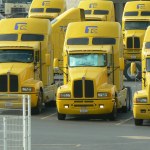
Mexican cross border drayage trucks revealed (28 photos – RAW)

OOIDA’ executive vice president Todd Spencer, continues to try and convince the public, the Courts and Congress that the companies participating in the Cross Border Demonstration Project re using the same trucks as the border shuttle fleet or drayage operators.

He insinuates this fleet is ill maintained, worn out junk rigs that have no place on US highways. But of course, he’s wrong as we’ve proved time and again on this site.

CANACAR, the Mexican equivalent of the ATA, with about 150 member carriers is working to change this perception and encourage member carriers to upgrade their drayage equipment

Whether or not they are having any success or it is simply the life cycle of the trucks, many Mexican carriers with drayage operations are indeed, upgrading their cross border shuttle trucks and retiring the old JB Hunt and Schneider cab overs we’re so used to seeing.

I always have my digital camera at the ready whether I am in the big truck or in my personal vehicle and shot some rigs around Laredo Texas as well as on a recent return from a weekend in Monterrey.

Draw your own conclusions. I’ve seen worse trucks around the US in truck stops and on the road.


The waits will be longer – Texas DPS threatens to disrupt border commerce

Texas Department of Public Safety Inspectors announced today their plans to cause a total disruption of border commerce in the Laredo sector

Texas DPS along with USDOT and FMCSA have been handing out pamphlets announcing their intentions of turning back at the border, any transfer driver who can not or will not respond to their questions in English.

Luis Brown Robert Sesma, president of the National Camera of the Motor transport de Carga (Canacar), expressed this week, his indignation of measures being announced, that the FMCSA and USDOT will take towards Mexican carriers.

“it is ridiculous to announce that they will put out of service the operators who do not speak English, it is understood when you go to the interior of the United States, but in the border region, to force them, that is not right”!

He added that according to a pamphlet which they are giving to Mexican shuttle drivers, that it is anticipated that ofnot responding in English to the personnel of the DPS, will cause them tobe put out of service and the operators and the carriers could be fined.

With nearly 5000 Mexican shuttle drivers operating in the area, it was determined by CANACAR representatives, that perhaps 2-3% speak English at a level of 30%.

FMCSA Regulation 391.11 (b)(2) specifies that commercial can read and speak the English language sufficiently to converse with the general public, to understand highway traffic signs and signals in the English language, to respond to official inquiries, and to make entries on reports and records.

We agree with this rule where it applies to the participants in the Cross Border Program and any other driver operating on the nations highways, but Mexico Trucker has a definite problem with the enforcement of the regulation in an area where English is realistically, a second language and 95% of the folks down here are bi-lingual.

This seems little more than harassment and a means to enhance the county coffers at the expense of these drivers who only make about $20 dollars per crossing.

We do things a little differently down here on the border and in the end, it all comes together and works smoothly and efficiently.

If this policy is enforced here, you can expect longer wait times for your trailers to cross the border, which means more idle time in the truck stops.

Let’s see, there are 5000 drivers, and only 3% speak acceptable English, that is 150 trucks to do the work of 5000.

Yep! ya’ll going be doing some sitting, measured days instead of hours!

Be careful what you wish for people! The repercussions ain’t nice!

CANACAR spokesman plan to complain to the Mexican government for relief. Mexico Trucker fully supports CANACAR this time and is in opposition to this incredibly stupid plan.

25 Mexican truckers protest enforcement actions by Transitos

Mexican truckers protest Transito extortion25 Mexican cross border operators gathered at the local offices of CANACAR to protest new rules issued by Gerardo Madrazo, head of the Nuevo Laredo Transito or Traffic division, prohibiting tractors within residential areas within the city.

In additions, Transito officers have been instructed to watch the most heavily traveled areas for the shuttle operators, Hwy 2 which come in from the Colombia Bridge and the Bridge III commercial crossing.

Transit officers seem to be demanding $50 pesos or about $5.00 US from operators for the privilege of taking their bob tail tractors home. When there is more than one officer in the car, the amounts increase proportionately.

But I wonder. It appears the new Transito chief is instructing his officers to enforce the laws for a change.

Numerous complaints from residents of Colonia Juarez, next to the terminals of a major trucking company, Transportes Especializados de Nuevo Laredo (TENL). Of course in all fairness, this trucking company has occupied the premises and the neighborhood has grown up around it.

Residents are complaining of trucks entering and leaving the compound at all hours of the day and night and parking outside the compound without regard to spaces for the residents autos. Sound familiar?

Nuevo Laredo Transito inspects Mexican carrierBut back to the transitos. The members of CANACAR seem to be upset because the Transito are being more diligent in enforcing motor carrier laws in Nuevo Laredo. Over dimension loads without proper permits.

Nuevo Laredo Transito are also authorized to make equipment inspections and cite or place Out of Service as deemed necessary.

And I bet you guys really believed the bullshit spoken by the Trucking Bozo, OOIDA and others that there is no commercial vehicle enforcement in Mexico.

To the contrary, the Mexican Enforcement Regulations are aligned with the USDOT regs in many ways. In the case of the crackdown, the appropriate sections of the code are quoted.

So what do the Mexican truckers find so unfair about the enforcement?


Los artículos 103, 104, 105, 106, 107 y 108 del Reglamento de Tránsito y Transporte Público, señalan lo siguiente:

Artículo 103.-

En los casos que dicte el interés público, la Secretaría está facultada para restringir la circulación, horarios y maniobras de los vehículos de transporte de carga, y en general de aquellos considerados en este Reglamento, como pesados.

(In cases that the public interest dictates, the Secretariat is empowered to restrict the movement, schedules and movement of vehicles for transporting cargo, and in general for those considered in this regulation, such as heavy haul.)

Artículo 104.-

Se prohíbe la circulación los vehículos de carga cuando ésta:

They can prohibit the movement of vehicles when:

I.-Sobresalga de la parte delantera del vehículo.

When the cargo exceeds the front limits of the vehicle

II.-Sobresalga de la parte posterior en más de un tercio de la longitud de la plataforma.

When it hangs over the back in access of 1/3 total length of the trailer

III.-Ponga en peligro a personas o bienes.

When it puts the public and others in danger
IV.-Estorbe la visibilidad del conductor o dificulte la conducción del vehículo.

When it obstructs the operators view or impedes operation of the vehicle

V.-Oculte las luces del vehículo, sus espejos retrovisores o sus placas de circulación; y When it hides the lights, blocks the mirrors or covers the license plates of the vehicle

VI.-Se trate de materias a granel que no vayan debidamente cubiertas.

In the case of bulk materials which are not properly covered or tarped

Artículo 105.-

Cuando se vaya a transportar carga que no se ajuste a lo dispuesto en el Artículo anterior, la Secretaría podrá conceder permiso especial y señalará las medidas de protección que deban adoptarse.

When you go to transport cargo that does not conform to the provisions of Article earlier, the Ministry may grant special permission and give the protective measures to be taken. In other words, issue a permit for the movement.

Artículo 106.-

Los vehículos de carga solamente transportarán la autorizada y sus conductores deberán portar la nota de remisión correspondiente.

Permit is valid for that truck and that cargo, and driver must have permit in his possession

Artículo 107.-

Los vehículos que transporten artículos susceptibles de esparcirse o derramarse, deberán cubrirlos y sujetarlos para que la carga quede debidamente asegurada.

If the truck is carrying a bulk load or a load which can be scattered or spilled, it must be adequately covered, secured and adequate insurance must be maintained.

Artículo 108.-

Cuando la carga de un vehículo sobresalga longitudinalmente en más de 0-50 metros de un extremo posterior, deberá colocarse una bandera roja durante el día y una reflejante o lámpara roja durante la noche, colocada en el extremo posterior de la carga, y que sean visibles a una distancia mínima de 150 metros.

When the length of the cargo exceeds more than 0-50 meters from the rear of the trailer, red flags must be displayed during the day and red lamps during the night at the extreme end of the overhang. These must be visible from a minimum distance of 150 meters.

Este Reglamento de Tránsito y Transporte Público, puede ser consultado en la misma página de internet del Gobierno Municipal de Nuevo Laredo que es www.nuevolaredo.gob.mx en el apartado de Gobierno donde aparece una pestaña de Leyes y Reglamentos.

You can find all the rules and regs of transit at this website

So I wonder with the recent purge of the law enforcement community in Nuevo Laredo, if these Transito officers are actually asking for the “merdida” to look the other way for minor violations, or if they are in fact, doing their jobs, and this has made the transportistas angry.

Considering in all the years I have lived in this country and traveled unrestricted with no problems from law enforcement in Mexico, I am thinking the latter is the case.

Transito officers inspects load of structural steelThe photo to the left shows a Transito officer inspecting the truck, the load and actually enforcing Mexico’s DOT laws.

In this case, a load of structural steel, properly flagged.

Although I think I would have used belly straps on this load in addition to top straps. But keeping in mind, this is a cross border shipment.

This last photo is the same scene. As you can see, our law enforcement is well equipped, part of the cities plan to instill pride and professionalism

And in other news from south of the border, CANACAR is looking for ways to help operators upgrade their border fleets. They want the old cabovers gone.

Transito doing a commercial vehicle inspectionSo you see people, there is not so much difference in the enforcement of commercial vehicle laws in Mexico as opposed to the US. In Mexico, the officers don’t seem to be as “anal” as some US DOT officers who will write you a citation when a simple word of caution would suffice.

Is it really about safety or the color of the driver’s skin

Protest in MatamorosThe opponents and most vocal critics of the Mexican Pilot Program continue to insist their opposition is only about safety and concern over the economic impact a few Mexican trucks will have on their ability to earn a decent living. Their words and actions would suggest otherwise.Protest in Matamoros

Thursday, October 4, a small group of Mexican truckers gathered at the Matamoros-Brownsville International bridge to protest Mexico’s participation in the Demonstration Program

Parked along the curbs near the entrance to the Veterans International Bridge, the drivers demanded equal treatment for Mexican and American truckers.

Read more