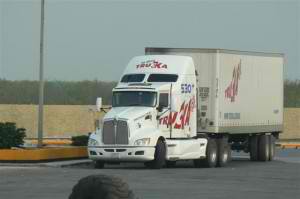
Coming to the highways and byways of America, this modern fleet of Mexican trucks owned by Servicios Refrigerados Internacionales, one of the latest carriers to pass their Pre-Authorization Safety Audit over the objections of OOIDA
Three more Mexican carriers have passed their Pre-Authorization Safety Audits (PASA) bringing them one step closer to being granted authority to participate in the much maligned Cross Border Pilot Program for Mexican carriers.
Higienicos Y Desechables Del Bajio, Servicios Refrigerados Internacionales and Transportes Del Valle De Guadalupe passed their audits easily and the findings were published in the Federal Register last Friday, giving the public the required 10 days to comment on the fitness of these carriers to participate in the program.
“Fitness” refers to the ability of the carrier to perform safely and comply with the rules, regulations and laws of the United States, something Mexican carriers have historically and statistically excelled at.
And as expected, The Owner Operators Independent Drivers Association (OOIDA), long an opponent of allowing Mexican trucks into the United States, came out with a statement from Executive VP Todd Spencer putting the powers that be on notice that the association is “reviewing” the applications to make certain all the “i’s” were crossed and the “t’s” dotted.
According to Spencer, who thanks to Mexico Trucker Online and others, has, in the past, exposed and debunked all the claims of Spencer and his organization that Mexican carriers and drivers are ill qualified, unsafe and pose a hazard to American motorists, is reduced to whining about these carriers having “affiliations” with other carriers.
Believe me folks, I’m not making this crap up! Spencer claims that current research on the three new applicants shows they have affiliations with other motor carriers. Oh, the horror of it all!
“I guess we should be used to the fact that the agency really isn’t checking out applicants,” Spencer whined.
“Applicants are required by law under severe penalties to disclose to disclose affiliations. They simply don’t. Apparently FMCSA thinks that’s good enough,” Spencer said. “Certainly we don’t believe that is good enough. Those affiliations do need to be disclosed. The fact that they are not should be on its face enough to disqualify them.
"Dangerous, unsafe, rolling junkyards" such as these 2011 Kenworth T-660's, at least that is the claim of opponents such as the Teamsters and OOIDA or poised to become a common sight on US highways. Mexican trucks and their drivers have historically returned safety and compliance ratings superior to US carriers
Apparently the months it is taking FMCSA to check out these carriers before performing the PASA’s doesn’t count in Spencer’s mind.
But once again, and as usual, Spencer and company is not telling the public and their members.
William Quaide, an FMCSA assistant director replying to OOIDA’s comments against Baja Express Transportes, making many of the same claims that they are making here, had this to say;
It is not uncommon for motor carriers from the United States, Mexico, and Canada to leave the affiliations question unanswered on operating authority applications. As a result, this alone is not grounds to reject an OP-1 or OP-1 (MX) application. For OP-l(MX) applications, the Agency requires that the affiliations question be answered and requests that applicants amend their applications with a
response to the question. The application will not be further processed until the missing information is supplied. If, an affiliation is identified, and the affiliated carrier has a record of significant non-compliance that may include, but is not limited to, out of service orders, an unsatisfactory compliance review, failed safety audit, Safety Measurement System (SMS) scores above the threshold levels, non-payment of penalties, and/or the appearance of reincarnation to avoid enforcement, these factors may lead to Agency dismissal of the application.
So, in other words, FMCSA is well aware of OOIDA’s attempts to side track or derail individual applicants who desire to participate in the program through asinine revelations that the applications were not properly signed or perhaps the carrier has an affiliation of some sort with another carrier, which in and of itself is not illegal. FMCSA and to his credit, Bill Quade, is having none of it.
We look forward to OOIDA’s comments on these three carriers and FMCSA’s reply dismissing them.
To date, 26 crossing have been made by two of the participants since the program started 7 months ago.
Download and read the FMCSA response to OOIDA here
Safe, well maintained commercial trucks from Mexicosuch as this one belonging to Transportes Olympic is what OOIDA and other opponents of Mexican trucking are trying to stop, and failing miserably.
OOIDA has filed its final reply brief April 4 in its frivolous DC Circuit Court of Appeals lawsuit to try and stop the Mexico Cross Border Pilot program. FMCSA has also filed it’s reply to OOIDA’s reply. Confused yet? It gets better.
For the record, the case in question is 11-1251. The document is 185 pages of the most convoluted “crap” one would ever want to read and is easily disproven by FMCSA’s reply.
OOIDA’s claims are nothing new from the smoke they’ve been blowing up peoples asses for more than 10 years.
They claim that;
- Elements of the program are precluded and illegal under Federal statutes. These include the ability to grant operating authority to Mexican carriers, acceptance of Mexican Licencia Federal de Conductors and the validity of Mexican medical certificates.
- The claim that OOIDA has granted exemptions and exception to Mexican carriers without following proper procedures.
- They question the level of “safety” achieved citing perceived differences in Mexican licensing standards, drug testing and medical standards, and finally,
- OOIDA is making the ludicrous claim that Mexican carriers will be held to lesser, more lax standards than their US counterparts.
You can download the entire 185 brief by clicking on the box below.
Download OOIDA Reply
FMCSA, in their reply brief, counters all of the bogus arguments made by OOIDA’s attorneys.
The governments brief is available for study by clicking on the box below.
Download FMCSA Reply
In response to OOIDA’s unsubstantiated claims, FMCSA argument is quite transparent and simple to understand. FMCSA positions are;
- OOIDA has not established or met it’s burden to prove standing in the case. In other words, there is no evidence that any OOIDA member has been or will be harmed economically or otherwise by the continuation of this program.
- FMCSA counters OOIDA’s arguments that Mexican carriers will not be required to comply with US regulation by pointing out that not only will they be required to comply, there are additional and unique requirements they must comply with that are not required of US or Canadian carriers and that the programs requirements are consistent with all US regulations.
- At the end of the argument, which is contained in the 74 page brief, that OOIDA’s arguments lack merit, something we’ve argued all along and firmly debunked.
Take a moment to download the briefs and make your own decision. FMCSA’s brief details minutely the history and the law that permits them to establish the pilot program and thoroughly blows out of the water, all the claims you’ve heard from OOIDA over the years trashing Mexico and it’s transportation industry.
If you notice while reading OOIDA’s brief and the accompanying government response, OOIDA’s agenda is crystal clear. Subvert, confuse and cloud the issue for their members and when all else fails, outright lie. OOIDA’s brief constantly whines about how FMCSA does not provide the most minute details for public comment. FMCSA addresses that and also addresses another whine by OOIDA that some documents are not translated into English. FMCSA’s response? Nothing in the statutes requires them to provide translation services to OOIDA.

Loading …
Safe, modern, well maintained Mexican trucks such as this one are applying for authority to operate in the US despite the best efforts of some who oppose them
]Despite the best efforts of OOIDA and others to force FMCSA to reject another applicant for the Mexico Cross Border Pilot Program, another carrier has been green lighted to participate in the program.
Baja Express Transportes, based in Tijuana, Mexico, has been granted provisional authority to operate throughout the United States. The company has one driver and one truck, a 2004 Freightliner cleared for participation.
Some may remember that Baja Express Transportes was accused of “lying” on their OP-1 (MX) application by OOIDA, an organization who has taken “untruthfulness” to a higher art form in regards to Mexican trucks when the owner of Baja Express Transportes failed to list an association with a US based Mexican carrier on his application, an oversight quickly remedied to the chagrin and outrage of OOIDA.
Abandoned by their puppet Congressmen who finally realized the futility and illegality of trying to prevent the US from abiding by their international obligations, OOIDA, the Teamsters and their allies among the various bogus safety groups have resorted to using the 10 day comment period required before these trucks can be given the green light, to stymie the efforts of the applicants and the FMCSA.
Fortunately, this time, they failed…… Again.
Mexican trucks such as these two are the targeted obsession of Teamsters, OOIDA and their allies whose lawsuit against allowing them legally required access has now been consolidated by the DC Court of Appeals
Today, the International Brotherhood of Teamsters responded to the FMCSA’s response to the Teamster’s frivolous lawsuit with a totally bizarre brief, full of spin and out and out lies. Nothing we haven’t come to expect from the opponents of Mexican trucks and of America fulfilling the promises we made to our southern neighbor.
The irrelevant little man who is President of Teamsters stated;
“The FMCSA makes the bizarre argument that our members aren’t harmed by a program that opens the border to low-paid truck drivers and dangerous, dirty trucks. Try telling that to our members.
U.S. commercial truck drivers must follow all U.S. safety regulations while Mexican drivers only need to follow selected Mexican regulations. The government is flat-out wrong to say Mexican trucks and drivers meet equivalent standards.”
So Hoffa begins his latest tirade with two well worn out lies, which have been totally debunked, proven false time and time again. Mexican trucks and their drivers MUST follow the same rules and regulations as US and Canadian drivers when operating in this country.
Dissecting the TEAMSTERS brief
The brief filed yesterday by the Teamsters doesn’t present any new arguments, instead reveals how the opponents of Mexican truck access are reduced to “grasping at straws” in their continuing failure to stop this legal obligation this country has under the rules of NAFTA.
In response to FMCSA’s claim that Teamsters and OOIDA do not have “standing” to file these actions in Federal Court, since they cannot prove “harm” to plaintiffs, TEAMSTERS have of course come up with TWO PEOPLE who have been IRREPARABLY HARMED, by the presence of an additional 3 Mexican drivers and 2 Mexican trucks in the US. The brief states;
Petitioners declarations establish that the safety of drivers and trucks disproportionatelyaffects IBT members, particularly members, such as declarants Deane Allen and Jack Cawood ,who drive in the west, southwest, and south – where much pilot-program activity will occur.
IBT members are not just any citizens, but those most likely to beharmed by highway safety problems
Opening Br. 19. Finally, FMCSA concedes that two IBT members have submitted declarations that “suggest injury or risk of injury” from pollution.
An IBT member whose asthma is aggravated by diesel exhaust from trucks regularly travels on a highway with significant trucking traffic from the border zone. Cawood Dec., ¶¶3, 8. He – and the many other IBT members who drive trucks in the west, southwest, and south (Kimball Dec., ¶7) – will be particularly harmed by the pollution the pilot program causes. That is enough to satisfy the requirement that NEPA petitioners show that they are “uniquely susceptible to injury.”
Petitioners have submitted detailed declarations from IBTmembers who live and drive in the area the pilot program will most affect and who are subject to the safety and environmental effects FMCSA has ignoredSo Mr. Caewood, a TEAMSTER, who has asthma, and who drives a diesel truck, would be “harmed” by the addition of a few more Mexican trucks on the nations highways? We don’t think so!
The Teamsters brief erroneously claims the Federal Motor Carrier Safety Administration breaks the following laws:
- It waives a law that trucks must display certain proof that they meet federal safety standards.
They are of course referring to the requirement to display a decal certifying compliance with Federal Motor Vehicle Safety Standards (“FMVSSs”). 49 U.S.C. §§30112(a), 30115(a). Considering these are the same types and brands of trucks US companies operate, and considering the fact that most of these trucks utilized by the Mexican carriers are purchased in the US, this argument is moot.
- It breaks the law requiring the pilot program to achieve an equivalent level of safety because Mexican drivers don’t have to meet the same physical requirements as U.S. drivers.
This is perhaps the biggest stretch. Mexican medical standards require a driver to recognize only the color “RED” while US medical requirements require recognition of “RED, YELLOW and GREEN”, the colors present in STOP LIGHTS. However, Stoplights are the same in Mexico and the US and Canada. Furthermore, Mexico’s medical standards are much tougher than the US standards inasmuch as they include a disqualifiers such as a BMI in excess of 35 as an example. Again, the opposition is merely grasping at straws.
- It breaks the law that Mexico must provide simultaneous and comparable access to U.S. trucks. Mexico cannot do so because of the limited availability of ultra-low sulfur diesel fuel in Mexico.
Teamsters are using this weak argument despite evidence to the contrary and they are assuming that US trucks would be in country to the point they would need to purchase Mexican fuel. ultra Low Sulphur Diesel is indeed widely available in the major metropolitan areas and the border region should US carriers need to purchase fuel in Mexico. However, with trucks averaging 6.5 miles per gallon and fuel capacity of 300 gallons, the need to purchase would not be there. Furthermore, nothing in NAFTA specifies this type of fuel be available and the FMCSA has no authority to demand it as a condition of participation in the program.
- It breaks the law that the pilot program must include enough participants to be statistically valid. The FMCSA’s proposal ensures that only the best Mexican trucks participate, which would allow it to justify letting any Mexican truck over the border in the future.
The lies, delaying tactics, corrupt politicians in the pocket of the Teamsters and OOIDA, up to this point, have assured that there will not be enough participants to provide a “statistically valid sample”, however, with the program being in it’s first six months and FMCSA taking extra care in approving participants, this will most likely change when the Mexican carriers can see the potential for a return on their investment. This is really an invalid argument until such a time as all interested carriers pass their PASA and are admitted to the program.
- It doesn’t comply with the environment requirement of the National Environmental Policy Act.
Perhaps the weakest of their arguments and the most disingenuous, is this argument. The Supreme Court ruled in 2004 that FMCSA does not have reason to conduct these reviews, although they were later done as required by FMCSA. Simply because the results do not satisfy the opposition, does not mean that FMCSA is not in compliance with something they are not required to comply with.
It’s the same old shit, different day, that will eventually be tossed by the Appeals Court.
However, should they somehow prevail, then expect the LEGAL TARIFFS to come roaring back with a vengeance. We don’t think that will happen though seeing the lack of interest in this issue by Congress and the toady politicians in the pocket of the TEAMSTERS and OOIDA.
Oral arguments on this are tentatively scheduled for April 2012 and a decision could be coming in summer
Anna Amos, director of safety programs for the Federal Motor Carrier Safety Administration, left, and Marcelo Perez, a transportation safety investigator for the agency, addressed Mexican truckers in Tijuana on Friday. —Photo – Alfredo Ortíz -SUT
The story in Friday’s edition of the San Diego Union Tribune brought to light the low level of participation in the Cross Border Pilot Program for Mexican carriers with the revelation that two officials from FMCSA were in Tijuana meeting with Mexican transportation stakeholders hoping to interest more Mexican carriers in participating in the program.
Part of the reason for the low level of participation in the program, according to Alfonso Esquér, Canacar’s representative in Tijuana is that the new program has far too many limitations.
According to CANACAR National President Juan Carlos Muñoz Márquez, “It is very complicated, it’s very expensive, and to tell you the truth, it hasn’t brought us any benefit.”
Transportes Olympics, the first carrier to participate and cross the border in the 2007 and 2011 program reportedly spent more than $10,000 to prepare for the first program.
Opponents of the program, Teamsters, OOIDA and so called bogus safety groups have preyed upon the fears, prejudice and ignorance of otherwise good solid American drivers, by convincing them that once the Mexicans are allowed in the United States, they’ll be in the unemployment line. A couple of hundred Mexican trucks are going to put 4 million US CDL holders out of business? Anyone believe that.
These opponents take it one step further, inciting hysteria among an ignorant populace that knows nothing about trucking, claiming that these “dangerous, unsafe Mexican trucks” driven by “untrained, unqualified, drug using Mexicans” will put the soccer moms families at risk. This is Teamsters President James P. Hoffa’s favorite rant, although it couldn’t be further from the truth.
And Mexican truckers do not operate as we do in the US. Most US carriers are out to haul freight on irregular routes. Mexican carriers operate under contract. Generally, they go out with a load and return to their domiciles with another load. Without established contracts with their customers in Mexico for a back haul into Mexico, or contracts in this country for the back haul, there is little benefit.
Opponents of Mexican Trucks use innacurate government data to press their case
CSA (Comprehensive Safety Accountability) the FMCSA’s new compliance measurement system for companies operating in the U.S, that replaced the old SAFERSYS database is responsible for inaccurate portraits of carrier performance and is being used by opponents of Mexican trucks, to paint a portrait of the carriers that is far from accurate.
Senior Editor Jami Jones of Landline Magazine, once a very competent journalist before becoming involved in the Mexican truck debate, posted a story yesterday based on the San Diego Union-Tribune report. And as usual, she puts a spin on it that reflects OOIDA’s policy of misinform, circumvent the truth and when necessary, lie about the Mexican trucking industry.
Jones writes:
For example, applying companies Servicio De Transporte International, Trinity Industries, Maria Isabel Mendivil, Luis Edmundo Grijalva Gamez, Transportes Unimex and Autotransportes Libre Comercio are all in alert status in the Driver Fitness BASIC. That BASIC tracks compliance issues in licensing, ability to read and speak English sufficiently, current medical certification, etc. All six of the motor carriers have a BASIC score of 99 percent or higher.
This is a prime example of what she fails to point out.Servicio de Transporte International based out Cd. Juarez, Chih, across the border from El Paso Texas, does indeed have a DRIVER FITNESS BASIC of 100%. On the surface, this appears bad. But what have the drivers been found in violation of?
The majority (1243) not being able to speak English to the satisfaction of the inspecting officer! This company is a commercial zone carrier and most would admit that 391.11(b)(2) is arbitrary and capricious inasmuch at it gives no guidance as to what is “competency” in the English language.
This same carrier shows in the FATIGUED DRIVER BASIC, 35 violations, out of 8,465 inspections of drivers not having log books. Log books are generally not required when operating within a 100 air mile radius of your home terminal which you return to each night, as these guys do.
And in the VEHICLE MAINTENANCE BASIC, the majority of violations are a Texas DPS specialty. 393.45(b)(2) Failing to secure brake hose/tubing against mechanical damage. 2434 violations. A trooper thumb against the airline leaves “evidence” of “chafing”. This is closely followed by 1043 incidents of a light out. It might only be a marker light, but that’s enough in this new age of CSA.
It’s happening to the Mexicans, the Canadians and our drivers.
Jones continues with her spin by informing that;
Two other motor carriers – one of which is Grupo (Behr) – have safety rankings in CSA. Grupo still maintains a 50.5 percent in the Vehicle Maintenance BASIC. GCC Transporte has scores of 47 percent and 57 percent in the Driver Fitness and Vehicle Maintenance BASIC respectively.
What Jones is insinuating is that these carriers are baaaddd having what would appear to be “high” percentiles in the various basics. However, the intervention thresholds for the various BASICS, meaning when FMCSA would take a look and send a warning letter, is
- UNSAFE DRIVING 60%
- FATIGUED DRIVING 60%
- DRIVER FITNESS 75%
- DRUGS/ALCOHOL 75%
- VEH. MAINT. 75%
- CARGO RELATED 75%
- CRASH 75%
So the insinuation is that these carriers have a poor safety history is totally bogus when in reality, they are quite safe.
And the company we chose to illustrate our point, .Servicio de Transporte International of Cd. Juarez. In the 24 month reporting period, only one accident. 8480 total inspections with an OOS rate of 8% for vehicles and 1% for drivers. For below the national average in the US of 20.72% and 5.51% respectively.
So far now, another reason for Mexican carriers to be skeptical about participating in a program that is not required under NAFTA.
And we can continue to expect the opponents such as OOIDA with their lies and misinformation to mislead the American trucker and the public at large and of course Teamsters President James P. Hoffa who recently claimed in a
totally bogus story in HuffPost that;
Mexico’s failure is especially egregious in the case of cross-border trucking. U.S. trucks and truckers have to meet much more rigorous safety standards than their Mexican counterparts. Carnage and crime prevent them from using Mexican highways. But Mexican trucks that don’t meet U.S. safety standards are allowed to drive on violence-free U.S. highways as part of the U.S. Transportation Department’s latest pilot program……..
Further proof that FMCSA is indifferent to highway safety came with the second company allowed into the pilot program. Transportes Olympic has one truck with a 33 percent out-of-service rate.
Apparently Hoffa is continuing to show his ignorance. Transportes Olympic has a 14% Out of Service rate based on FMCSA’s CSA database for a “light out”. This from 11 inspections on 1 truck since the program started.
As Marcelo Perez, the transportation safety investigator for FMCSA said during last Fridays meeting,
When the previous pilot project was suspended in 2009, “no one was able to say that Mexican carriers are any less safe than U.S. carriers. The only thing they could say was that the project did not have sufficient data to come up with a statistically valid decision. That’s where we find ourselves today, needing you to participate in this program so that we don’t come up with another draw.”
Personally, we don’t see the need for any type of cross border program as Mexican carriers have historically been and continue to be as safe, if not safer than their US and Canadian counterparts.
From THE TRUCKER- Essentially saying they have “no dog in the hunt,” the Department of Transportation and Federal Motor Carrier Safety Administration Wednesday responded to lawsuits by the Owner-Operator Independent Drivers Association and the International Brotherhood of Teamster challenging the legality of the cross-border trucking pilot program.
“OOIDA’s members are not regulated by the program, or eligible to participate in it, and therefore its standing cannot be presumed,” the DOT and FMCSA said in their response. “OOIDA’s allegation of an increased risk of injury to its member is not sufficient … absent a showing that some identifiable member of the group faces a ‘substantially’ increased risk of harm and that the overall risk of such harm is ‘substantial.’”
The response said that OOIDA’s competitive standing arguments are also flawed.
“OOIDA cannot show that the program will almost surely cause its members to lose business, because the vast majority of the cross-border deliveries are likely to be made in the commercial zones by carriers already authorized to operate there and because Mexico-domiciled carriers are prohibited from making point-to-point deliveries of domestic freight.”
The pilot program creates a double standard, OOIDA said.
“The obligation of the U.S. under NAFTA to provide national treatment to Mexico-domiciled motor carriers is in complete harmony with U.S. statutes and regulations governing motor carrier safety,” OOIDA said in its suit.
“The respondent’s (DOT and FMCSA) pilot program goes well beyond what is required to provide national treatment to Mexico-domiciled motor carriers and drivers. The pilot program violates a number of federal statutes and regulations, causing prejudice to U.S. motor carriers and drivers who must follow all U.S. safety regulations while their Mexican counterparts are instead allowed to comply with selected Mexican regulations.
There is not a single word in FMCSA’s proposal or final order explaining why this double standard has been created.”
In filing its suit against the program, the Teamsters said the FMCSA had failed to comply with safety statutes and regulations that expressly govern the granting of any long-haul operating authority to Mexico-domiciled trucking companies and ensure the safe operation of trucks on the nation’s highways.
The Teamsters said that FMCSA had created a program that was not assured of having a sufficient or representative sample of Mexico-domiciled motor carriers to yield valid findings and merely presumes — but cannot demonstrate — that Mexico-domiciled trucks are as safe as their U.S. counterparts.
The DOT and FMCSA response noted that Teamster members were not regulated by the program or eligible to participate in it.
Their response also said that “Congress has enacted multiple statutes containing preconditions for any test of opening the border to long-haul operations by Mexico-domiciled carriers.
“FMCSA has explained how the pilot program challenges here meet each of those preconditions as well as the existing motor carrier safety laws and regulations,” the agency said.
Outside his company’s warehouse in Otay Mesa, truck driver Jorge Villanueva inspected his 24-foot GMC on Wednesday. The bobtail box-truck is operated by Tijuana-based Grupo Behr, which has applied to participate in a pilot program that allows Mexican truckers to make deliveries across the United States. / Photo by Nelvin C. Cepeda * U-T
Grupo Behr, the Mexican carrier who was the first victim of OOIDA’s campaign of propaganda and misinformation, has allegedly been found to be in violation of leasing statutes in Section 219 of the 1999 Motor Carrier Safety Improvement Act, according to William Quade assistant administrator for FMCSA’s Enforcement and Compliance division.
Section 219 of the 1999 Motor Carrier Safety Improvement Act was intended to end the ability for a Mexican carrier to lease trucks and drivers to a U.S.carrier for operations beyond the authority the Mexican carrier could get clearance for on its own. That ability was for commercial zone authority commonly referred to as OP-2 authority.
FMCSA issued a notice to Grupo Behr, whose headquarters are in Tijuana Baja California for violating Section 219, but FMCSA chose not to pursue civil penalties. “Our preliminary decision is to monitor the situation for six months to consider whether we should allow them into the program,” Quade added.
Grupo Behr successfully completed their PASA last year but approval to participate in the program was put on hold after OOIDA erroneously claimed that Grupo Behr would be operating pre- 1995 semi’s and straight truck in the project.
MTO spoke to a representative of Grupo Behr who said that critics’ accusations about lax safety standards are unfounded and erroneous.
Roberto García de León, managing partner of Grupo Behr said, “They’re accusing us about vehicles that we haven’t even enrolled in the program,” a fact MTO uncovered shortly after OOIDA made their outrageous and totally false claims again GB.
Grupo Behr also participated in the 2007 pilot program successfully. Currently, under CSA, their SMS scores are consistent or slightly below the US national average. 21% out of service for equipment and 3% OOS for drivers.
Sufficient data is becoming available for the FMCSA to begin to publish status reports for the Mexican carriers participating in the Mexican Cross Border Pilot Program.
The weekly updates can be accessed at FMCSA’s website.
This is part of the transparency of the program required under the rules for the program and which groups who oppose Mexican trucking claims not to exist.
Here’s an overview of the first report published. It covers the week of 10/21/2011 through 10/31/2011.
Transportes Olympic has made 2 crossings using 2 drivers in one truck.
There was one inspection done on Transportes Olympics trucks as required under the pilot program rules. Since Transportes Olympics was eligible and granted, permanent operating authority after factoring in their successful 18 month participation in the previous program, further inspections are not mandated every time one of their trucks crosses the border.
No drivers nor vehicles were placed Out-of-Service during this period of time.
There were no violations of terms of any participants operating authority.
Review of data from EOBR’s placed on-board the truck belonging to Transportes Olympics revealed one violation of Hours of Service Rules, however, upon investigation FMCSA determined that the driver’s sleeper berth period was interrupted for 2 minutes due to a need to relocate the vehicle. Activities that momentarily interrupt a driver’s sleep are not considered to interrupt the driver’s sleeper berth status.
The drivers Licencia Federal de Conductors were checked and licenses were found to be active.
There were no reportable crashes nor other violations found during this period.
A third applicant, Moises Alvarez Perez DBA Distribuidora Marina El Pescador, a refrigerated carrier has undergone their PASA and awaiting the results from FMCSA.
Much ado about nothing.
Readers Reponses