Mexico Trucker Online Articles

Mexico SCT tightens rules, lowers weights, for Mexican trucks after Mexican truckers protest

Mexico SCT tightens rules, lowers weights, for Mexican trucks after Mexican truckers protest

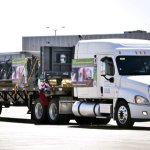
Double trailer truck in Mexico

Double trailer such as this example are now prohibited in Mexico by a recent SCT rule change followings protests by Mexican truckers

US truckers could take a lesson from their cousins south of the border in Mexico. Nationwide protests and blockades by Mexican truckers against the use of double 53″ trailers and 80 metric ton weight limits was heard by the government in Mexico City.

The Mexican government said Friday it will tighten inspections and lower maximum allowed weights for big rigs after Independent truckers partially blocked highways leading into Mexico City to protest rules allowing extremely heavy and very long trucks, something they say displaces them from hauling jobs and pressures them to overload their own rigs.

Mexico law currently allows trucks to access two-lane roads with loads of up to 80 metric tons and lengths exceeding 100 feet, compared to a U.S. limit of is 80,000 pounds (40 tons) on interstate highways.


Read more


Teamsters “Bizarre” response to FMCSA on Mexican truck issue

Teamsters “Bizarre” response to FMCSA on Mexican truck issue

Mexican trucks such as these two are the targeted obsession of Teamsters, OOIDA and their allies whose lawsuit against allowing them legally required access has now been consolidated by the DC Court of Appeals

Today, the International Brotherhood of Teamsters responded to the FMCSA’s response to the Teamster’s frivolous lawsuit with a totally bizarre brief, full of spin and out and out lies. Nothing we haven’t come to expect from the opponents of Mexican trucks and of America fulfilling the promises we made to our southern neighbor.

The irrelevant little man who is President of Teamsters stated;

“The FMCSA makes the bizarre argument that our members aren’t harmed by a program that opens the border to low-paid truck drivers and dangerous, dirty trucks. Try telling that to our members.

U.S. commercial truck drivers must follow all U.S. safety regulations while Mexican drivers only need to follow selected Mexican regulations. The government is flat-out wrong to say Mexican trucks and drivers meet equivalent standards.”

So Hoffa begins his latest tirade with two well worn out lies, which have been totally debunked, proven false time and time again. Mexican trucks and their drivers MUST follow the same rules and regulations as US and Canadian drivers when operating in this country.

Dissecting the TEAMSTERS brief

The brief filed yesterday by the Teamsters doesn’t present any new arguments, instead reveals how the opponents of Mexican truck access are reduced to “grasping at straws” in their continuing failure to stop this legal obligation this country has under the rules of NAFTA.

In response to FMCSA’s claim that Teamsters and OOIDA do not have “standing” to file these actions in Federal Court, since they cannot prove “harm” to plaintiffs, TEAMSTERS have of course come up with TWO PEOPLE who have been IRREPARABLY HARMED, by the presence of an additional 3 Mexican drivers and 2 Mexican trucks in the US. The brief states;

Petitioners declarations establish that the safety of drivers and trucks disproportionatelyaffects IBT members, particularly members, such as declarants Deane Allen and Jack Cawood ,who drive in the west, southwest, and south – where much pilot-program activity will occur.

IBT members are not just any citizens, but those most likely to beharmed by highway safety problems

Opening Br. 19. Finally, FMCSA concedes that two IBT members have submitted declarations that “suggest injury or risk of injury” from pollution.

An IBT member whose asthma is aggravated by diesel exhaust from trucks regularly travels on a highway with significant trucking traffic from the border zone. Cawood Dec., ¶¶3, 8. He – and the many other IBT members who drive trucks in the west, southwest, and south (Kimball Dec., ¶7) – will be particularly harmed by the pollution the pilot program causes. That is enough to satisfy the requirement that NEPA petitioners show that they are “uniquely susceptible to injury.”

Petitioners have submitted detailed declarations from IBTmembers who live and drive in the area the pilot program will most affect and who are subject to the safety and environmental effects FMCSA has ignoredSo Mr. Caewood, a TEAMSTER, who has asthma, and who drives a diesel truck, would be “harmed” by the addition of a few more Mexican trucks on the nations highways?  We don’t think so!

The Teamsters brief erroneously claims the Federal Motor Carrier Safety Administration breaks the following laws:

  • It waives a law that trucks must display certain proof that they meet federal safety standards.
They are of course referring to the requirement to display a decal certifying compliance with Federal Motor Vehicle Safety Standards (“FMVSSs”). 49 U.S.C. §§30112(a), 30115(a). Considering these are the same types and brands of trucks US companies operate, and considering the fact that most of these trucks utilized by the Mexican carriers are purchased in the US, this argument is moot.
  • It breaks the law requiring the pilot program to achieve an equivalent level of safety because Mexican drivers don’t have to meet the same physical requirements as U.S. drivers.
This is perhaps the biggest stretch. Mexican medical standards require a driver to recognize only the color “RED” while US medical requirements require recognition of “RED, YELLOW and GREEN”, the colors present in STOP LIGHTS. However, Stoplights are the same in Mexico and the US and Canada. Furthermore, Mexico’s medical standards are much tougher than the US standards inasmuch as they include a disqualifiers such as a BMI in excess of 35 as an example. Again, the opposition is merely grasping at straws.
  • It breaks the law that Mexico must provide simultaneous and comparable access to U.S. trucks. Mexico cannot do so because of the limited availability of ultra-low sulfur diesel fuel in Mexico.
Teamsters are using this weak argument despite evidence to the contrary and they are assuming that US trucks would be in country to the point they would need to purchase Mexican fuel. ultra Low Sulphur Diesel is indeed widely available in the major metropolitan areas and the border region should US carriers need to purchase fuel in Mexico. However, with trucks averaging 6.5 miles per gallon and fuel capacity of 300 gallons, the need to purchase would not be there. Furthermore, nothing in NAFTA specifies this type of fuel be available and the FMCSA has no authority to demand it as a condition of participation in the program.
  • It breaks the law that the pilot program must include enough participants to be statistically valid. The FMCSA’s proposal ensures that only the best Mexican trucks participate, which would allow it to justify letting any Mexican truck over the border in the future.
The lies, delaying tactics, corrupt politicians in the pocket of the Teamsters and OOIDA, up to this point, have assured that there will not be enough participants to provide a “statistically valid sample”, however, with the program being in it’s first six months and FMCSA taking extra care in approving participants, this will most likely change when the Mexican carriers can see the potential for a return on their investment.  This is really an invalid argument until such a time as all interested carriers pass their PASA and are admitted to the program.
  • It doesn’t comply with the environment requirement of the National Environmental Policy Act.

Perhaps the weakest of their arguments and the most disingenuous, is this argument. The Supreme Court ruled in 2004 that FMCSA does not have reason to conduct these reviews, although they were later done as required by FMCSA. Simply because the results do not satisfy the opposition, does not mean that FMCSA is not in compliance with something they are not required to comply with.

It’s the same old shit, different day, that will eventually be tossed by the Appeals Court.

However, should they somehow prevail, then expect the LEGAL TARIFFS to come roaring back with a vengeance. We don’t think that will happen though seeing the lack of interest in this issue by Congress and the toady politicians in the pocket of the TEAMSTERS and OOIDA.

Oral arguments on this are tentatively scheduled for April 2012 and a decision could be coming in summer


Mexico’s “Paperless Port” due to go online in March

Mexico’s “Paperless Port” due to go online in March

Mexico initiates "Ventanilla Unico"

The federal government established the One Stop Shop as a tool to send electronic information only once to a single entity, to comply with all requirements of foreign trade.

About a year ago, Mexican President Felipe Calderón Hinojosa signed a decree for the implementation of the Single Window of Foreign Trade, or “Ventanilla Unico” to streamline and consolidate Mexican Customs clearances. The new system is currently undergoing extensive testing which began last November. According to Alfonso Rojas Gonzalez de Castilla, president of the Confederation of Customs Brokers Associations of Mexico (CAAAREM), plans are for the system to be fully implemented by March.

“It is an excellent tool to simplify procedures, reduce waiting times and this will mean that the clearance of goods will be more agile and efficient,” said Alfonso Rojas Gonzalez.

This is nothing new. The United States has a similar system called ACE on the northern border with Canada. Other countries such as Germany, Singapore, South Korea, Thailand, Finland, Mauritius, Japan, Hong Kong, Guatemala, Ghana, Paraguay, Malaysia, Colombia and others, already have this procedure in place and are profiting from the benefits and reduced redundancy.

But what is the Single Window or Ventanila Unico?

Line at US Mexico border

Single Window should drastically reduce waiting times and traffic jams such as this one at Laredo Texas

It is a tool that allows brokers, carriers and other import export professionals to send electronic information only once to a single entity, to be able comply with all requirements of foreign trade, through simplification, standardization and automation of management processes.

Currently Mexico processes a total of over 37,000 export permits, more than 1,000,000 import permits and more than 10 million inquiries, from more than 55 000 active participants in foreign trade, according to figures released recently by the Ministry of Economy.

Under the present system, more than 40 documents and 165 tramites need to be completed to cross one load of freight. The new system will result in a reduction in paper, provide flexibility in the often anal procedures of the Mexican customs system and provide more transparency of the process and provide more legal certainty among other issues.

The new system should also result in a time savings of more 90% in dealing with Mexican Customs, 11% reduction in the need for inspections by the Mexican taxing authorities and a gain of more than 50% productivity for the cross border drayage carriers who often have to wait for hours in line to cross into the US.

Not everyone supports Single Window though.

Interior Customs check

New Mexican immigration and Customs booths south of Nuevo Laredo on Mx 85

Proving that the Mexican transportation industry isn’t much different from ours, Customs agents and employees of import/export agencies don’t have much confidence in the new system. Others are looking at nothing but negatives. Think actions like Teamsters and OOIDA.

Comments taken from the pages of El Manana eerily echo comments made about Mexican trucking in this country and other issues targeted by those in the US resistant to change.

One reader wrote;

“Pure lies, from the name of Single Window are only adding another link in the chain of ‘requirements’ for import and export procedures, those who work in agencies know what I mean.

And another commenter calling himself “Pepe” had this to add;

“Now they will have to capture and validate all the bills and then recaptured in the motion, benefiting those who sold electronic equipment, big business at the expense of the people,”

Where have we heard those words “big Business” bantered around?

Others are doing the right thing and taking a “wait and see” attitude. These include workers at the agencies that will be effected who talked on condition of anonymity.

“They talk about benefits and streamlining of procedures, we hope so and there are no problems while we get used to this new system, which should improve the system greatly.”

Time will tell as to how successful the new system is. But nobody can argue that Mexico needs an overhaul of its antiquated customs system.


Racist Hate Group ALIPAC and President William Gheen use Mexican truck issue to defraud elderly

Racist Hate Group ALIPAC and President William Gheen use Mexican truck issue to defraud elderly

Alipac President William Gheen using the Mexican truck issue to scam the unwary out of money to fund his little organization

Once again, ALIPAC President William Potter Gheen III is using a current event in his pathetic attempt to defraud American’s elderly population into donating to his nativist hate group, wrongfully called “Americans for Legal Immigration”.

That’s right folks, Gheen, in the midst of his third attempt this year to scam unsuspecting old folks and others who are scared to death of a mythical “Mexican invasion” using the issue of Mexican trucks.

As my readers already know, one carefully inspected and closely monitored Mexican carrier has been given authority to operate in the United States under the recent Cross Border Pilot Program with Mexico. At the moment, there are another 14 Mexican carriers undergoing the security and background checks and Pre-Authority Safety Audits, (PASA) required under the rules for the pilot program.

But as is normal for this piece of pond scum, Gheen is spreading the hysteria.

Her writes;

After fighting them back for more than ten years, Americans now face a crushing blow.

Unless Americans on the left and the right unite to stop the Mexican Truck program authorized by NAFTA, over 150,000 unsafe Mexican trucks loaded with drugs and illegal aliens will roll into every state and community!

If this happens, and without a strong response from you it will, then over 100,000 American truckers will lose their jobs.

Border level drug and illegal alien interdiction efforts will become completely moot as the designers of this ‘North American Integration’ treason desire.

Untold numbers of innocent Americans will perish at the hands of unqualified Mexican truck drivers who are inexperienced at driving on 1st world roadway systems, unsafe Mexican trucks, and the increased amount of deadly addictive drugs and illegal immigrant invaders brought into our American communities. The organized crime syndicates will have a new powerful tool in the stripping down of America if this planned trucking integration happens.

This is even more radical than anything Teamsters President James P. Hoffa or OOIDA Vice President Todd Spencer could ever come up with, and the sad thing is, the elderly who he constantly targets, the bigots and racists whom he courts and the other fringes of American society who embrace his hateful rhetoric will swallow this kool aid hook, line and sinker!

But as usual, this assklown is a day later and a dollar short.

Gheen uses an article from the Latin American Times which allegedly quote an official with CANACAR, Mexico’s transport union as claiming 150,000 Mexican trucks are awaiting clearance to enter the country. We contacted CANACAR in Nuevo Laredo Tamps, and advised us they knew nothing of the person, Luis Moreno, listed as “Vice President” of the association.

But that doesn’t stop Gheen from continuing with his lies and fearmongering but fortunately, people are wising up to his scams and schemes, except for the elderly who continue to fall victim to his fraud.

Gheen claims his small organization has a membership of 40,000 or more. The truth is he has perhaps 35 hard core followers and a mailing list of about 35,000 who he spams regularly with his appeals for donations.

Buyer beware!


Transportes Olympics granted “Permanent Operating Authority” under new Pilot Program Rules. OOIDA cries “Foul”

Transportes Olympics granted “Permanent Operating Authority” under new Pilot Program Rules. OOIDA cries “Foul”

Transportes Olympic national fleet

The Transportes Olympics is not a small fleet despite only offering 2 trucks for inclusion into the Cross Border Pilot Program

After the completion of their first trip to Garland Texas under the new Cross Border Pilot Program, Transportes Olympics has been granted “permanent operating authority” by the FMCSA as specified in a Memorandum of Understanding (MOU) regarding the cross border program.

The announcement was made last Wednesday by FMCSA North American Borders Specialist Carla Vagnini at the fall meeting of the Canadian Council of Motor Transport Administrators that was held in Ottawa.

Under the rules, Transportes Olympics will no longer be required to undergo a Level I CVSA inspection each time it crosses into the United States under the program.

The MOU states the “permanent operating authority cannot be suspended or revoked unless the motor carrier receives an unsatisfactory safety rating pursuant to U.S. laws and regulations.”

The memorandum also states that Mexican motor carriers with permanent operating authority may convert to standard permanent operating authority “upon termination or conclusion of the initial phase (pilot program).”

The operating authority was “earned” not given to Transportes Olympics because of their successful 18 month participation in the previous pilot program in 2007.

Of course not everyone is happy, especially that “joke” of an executive vice president of OOIDA who stated;

“It goes to show how much of a joke this so-called pilot program actually is. Our government should be ashamed!”

Spencer goes on to spin it his way, which as usual has no relationship to the truth of the matter. Spencer claims that Transportes Olypmics is being given special treatment and “IRREVOCABLE” permanent operating authority. No operating authority is irrevocable.

According to an article by Landline Magazine Senior Editor, OOIDA is claiming that Transportes Olympic is being given “special consideration” on matters that would cause other “new entrants” to be denied authority or have their authority revoked.

“Transportes is being given permanent, irrevocable authority to operate throughout the U.S. based upon the 18 months they participated in the 2007 demonstration program even though a compliance review completed at the end of that program showed that Transportes had violations that would have caused a new entrant carrier in the U.S. to lose their operating authority.”

Transportes had a number of violations in its 2009 compliance review following the previous demonstration program, which included violations such as using a driver before the motor carrier has received a negative pre-employment controlled substance test result and failing to ask employees about a positive test or a refusal to test in the previous two years.

The company also notably violated a subsection of 383.305, random testing. That, according to the FMCSA’s list of the industry dubbed 16 deadly sins for new entrants, would be an automatic failure for U.S. companies getting their authority to operate for the first time.

That’s the claim being made. Let’s discover the truth together, shall we?

TRANSPORTES OLYMPICS COMPLIANCE REVIEW 02/24/2009

OOIDA is basing their accusation from a compliance review conducted on Transportes Olympics on 2/24/2009 at their headquarters in Apodaca, Nuevo Leon in which they received a SATISFACTORY rating. And for the record, at the time of this review, Transportes Olympics WAS NOT a new entrant, having been a participant in the 2007 demonstration project at the time. They had passed a “new entrant” compliance review on 6/25/2003. Transportes Olympics has been in existence since 3/29/1994.

During the review, the FMCSA inspector found 8 areas of concern.

Transportes Olympics 2009 Compliance Review

Section Violation Desc # Violations/Items Inspected
382.105 Failing to ask employee if any pre-employment test conducted in the preceding two years resulted in a positive test result or refusal to test. 1
382.301(a) Using a driver before the motor carrier has received a negative pre-employment controlled substance test result. 1
382.305(b)(1) Failing to conduct random alcohol testing at an annual rate of not less than the applicable annual rate of the average number of driver positions. 1
382.603 Failing to ensure persons designated to determine that drivers undergo reasonable suspicion testing receive 60 minutes training for alcohol and/or 60 minutes of training for controlled substances. 1
391.21(a) Using a driver who has not completed and furnished an employment application. 3
391.23(e) Failing to request information from all previous DOT regulated employers that employed the driver within the previous three years from the date of the employment application, in a safety- sensitive function. 1
395.8(e) False reports of records of duty status 3/150
395.8(f) Failing to require driver to prepare record of duty status in form and manner prescribed. 1/150

Perhaps, as Spencer claims, some of these could have been part of the superfluous “19 deadly sins” that could result in a new entrant being denied authority. But again, Transportes Olympic was not a “new entrant”.

Here’s what the on site FMCSA inspector had to say.

Part 40/382

Carrier hired 3 new CDL drivers in the last 365 days. As per EFOTM carrier was to test 3 drivers for pre-employment.Carrier used 1 of 3 drivers before receiving a negative pre-employment test result. Carrier had an average of 5 driversworking for them last year and was required to random drug test 3 drivers for drugs and 1 driver for alcohol. Carrier didrandom test 3 drivers for drugs but did not conduct the required 1 random alcohol test. Carrier conducts their own randomselection by using the program Randomizer purchased by them over the internet. All drug testing is done by either QuestDiagnostics Mexico SA de CV, PH # (811) 093-0862 and Rio Physical Medicine Center, 5505 S. Expressway 77, Suite #200, Harlingen, TX. 78550, PH # (956) 412-2200. Annual rate was calculated by 4 quarters. Lastly, the carriers lone person who has direct contact with the drivers did not have reasonable suspicion training.

Part 383

As per CDLIS Sampling Criteria all driver CDL’s were checked and verified.

Part 391

Carrier has an average of 5 driver positions and 5 DQ files were checked and violations were noted: Incomplete application and no background drug and alcohol check.

Part 395

Carrier has an average of 5 driver positions and as per EFOTM, I was required to check 5 drivers and 150 RODS andviolations were noted: false records and form and manner violations. Supporting documents such as bill of ladings, tripsheets, Comdata, toll receipts (int’l bridges and toll roads), fuel receipts, payroll records, and scale tickets were provided tome by Mr. Chavez to verify any falsification of time records. Carrier also uses J.J. Keller’s “Driver Management System” tocheck logs for violation of the 11,14, and 70 hr rule as well as form and manner violations. Carrier also has an HOS policythat requires each driver to sign a statement when they have an HOS violation.

Part 393/396

Carrier currently operates 5 truck tractors and 57 trailers. As per EFTOM a total of 13 vehicles were checked formaintenance files and no violations were found. As per EFOTM a total of 11 vehicles and 330 DVIR’s were to be checked. Idid not meet sampling size even though I increased my sample size to 31 vehicles as per trailers being pulled by trucktractors and still was short of the 330 days. A total of 226 DVIR’s were checked and no violations were found. Lastly, 2 of 2mechanics both had their CMV inspector and brake inspector qualifications.

Most importantly, the FMCSA inspector concluded;

Enforcement will not be recommended at this time. I left the carriers office with the satisfaction that they will comply witheverything they were written up on. I recommend compliance monitoring on this carrier at this time.

We choose to believe the inspectors conclusions instead of falling for Spencer’s continued buffoonery and slanted opinions.

Transportes Olympics OOS rate and accident rate was 0% for the past 365 days as found during the review.

The entire COMPLIANCE REVIEW can be seen HERE


Mexican Cross Border Pilot Program officially underway as first Mexican truck arrives at Laredo

Mexican Cross Border Pilot Program officially underway as first Mexican truck arrives at Laredo

2009 Freightliner Cascadia, Transportes Olympic #76

Josue Cruz, a driver for Transportes Olympic inaugurated the new Mexico Cross Border Pilot Program when he arrived in Laredo today on his first trip to Garland Texas

An editorial caught me eye this morning, on this day that the first Mexican carrier to be granted authority to operate beyond the commercial zone enters the U.S. It reads in part;

When a nation signs and ratifies a treaty with another, it is in effect a contract between those countries.

And when one country later simply decides it does not like the terms of the treaty and unilaterally decides to stop abiding by those terms —- well, that nation isn’t behaving very honorably, is it?

The roadblocks being thrown up by groups like OOIDA and the Teamsters that have prevented the United States from honoring their contract is nothing short of dishonorable.

Today changes that as a truck belonging to Transportes Olympics of Apodaca Nuevo Leon and driven by  Joshua Cruz, 29 and a father of three from the Monterrey area. Cruz, who has been driving for Transportes Olympic since March has more than 10 years experience behind the wheel.

[pullquote]“I consider my  fleet’s access to the U.S. interior like being invited to a friend’s house. ”We have to be extra orderly and very respectful. We will demonstrate that we can operate safely and efficiently.” Fernando Paez Trevino [/pullquote]

Cruz, driving a 2009 Freightliner Cascadia, unit number 76 will be pulling flatbed with a 30 foot drilling tower to Garland Texas for a 0700 delivery appointment on Saturday with Atlas Copco Drilling Solutions, which specializes in the manufacturing and marketing of equipment used in drilling and exploration industries such as oil, water, mining, among others. The tower originated from  INMAGUSA in Monclova Coahuilla and arrived on Transportes Olympics Apodaca terminal yesterday.

After leaving Apodaca this morning, Cruz arrived at Bridge #3 in Laredo to plenty of fanfare and celebration. Greeting Cruz as he began the inspection process that all of the participants must undergo each time they cross the border, was the Secretaries of Economy and Transport and Communications, Bruno Ferrari and Dionisio Perez-Jacome, respectively, the U.S. ambassador in Mexico, Anthony Wayne, and the governor of Tamaulipas, Egidio Torre Cantú.

“With this program, we’re initiating a new stage of competition, of prosperity, of regional integration,” said Bruno Ferrari, Mexican secretary of the economy.

U.S. Ambassador Anthony Wayne said governments “have to support the businesses in their efforts to reduce costs and accelerate trade.”


Following the Level I CVSA inspection by personnel from the FMCSA and Texas DPS, something not required of the Canadians when they enter the country, Cruz will proceed up I-35 to his destination in Garland Texas.

Hours before today’s  ceremony in the border city of Nuevo Laredo, Mexico announced it was suspending the tariffs. But the Mexican government warned that they would be reinstated if the U.S. does not honor the accord.

Transportes Olympic, a wholly owned Mexican company established in 1999 was also the first carrier authorized to cross during the successful 2007 demonstration project, which was defunded by Congress under threats from the Teamsters and others.

Transportes Olympics successful participation in the previous program gives them a “fast track” to permanent operating authority under the rules of the current program, something they have certainly earned and deserve.

So now we sit back and observe as this program commences and once again the Mexican carriers who are approved show once again that they are more than capable of operating in this country, complying with our rules and regulations and conducting themselves in a safe and professional manner as they have in the past.

Juan Carlos Munoz, president of Mexico’s largest trucking trade group, known by its Spanish initials as CANACAR, noted that opposition remains in Mexico. Some Mexican trucking companies doubt that the U.S. will treat them the same as American drivers.

“But we can’t cry before they hit us, as we say here in Mexico,” Munoz said. He called Friday’s activity the “first step on a long climb.

We’ll also sit back and chuckle a little at each impotent attempt to demonize the program and it’s participants as is continuing by the Teamsters and OOIDA and their allies in Congress.

And indeed it is impotent attempts as acknowledged by Rep. Peter DeFazio (D-OR) who acknowledged yesterday that he was losing the fight to stop this legal obligation of ours. DeFazio has had no success in getting his HB-2407 bill out of committee that would limit this to a pilot program. He acknowledges that he has little chance of getting an amendment into a continuing appropriations bill. Indeed, 9 out of 10 calls to Congress have been in support of the program.

And should by some strange twist of fate, the opponents succeed in once again delaying, defunding or causing the program to be suspended or scrapped, Mexico stands ready to bring the tariffs back with a vengeance, as they have every right to do.

Get used to it people! These well managed, closely monitored Mexican carriers are here to stay. Instead of beating your heads against the wall, making empty threats against the drivers, perhaps we should be looking at ways to profits from their presence. After all, Mexican trucks are nothing new to American roadways. They’ve been allowed for more than 60 years. You haven’t realized this because the Mexicans rarely do anything that brings attention to them. In other words, they operate in a safe professional manner under the same rules as US drivers and the 37,000 Canadian trucks that enjoy full access to the US with little oversight.


FMCSA voice concerns over minor issues with Mexican Driver Testing Centers

FMCSA voice concerns over minor issues with Mexican Driver Testing Centers

Licencia Federal de Conductor testing centers

Requirements for a Licencia Federal, Mexico's equivalent of a CDL, recognized as such since 1001 by FMCSA, requires a much stricter regimen of testing than those applying for a US CDL

As part of it’s effort to get the Cross Border Pilot Program with Mexico up and running, FMCSA has been diligently complying with all the roadblocks thrown in their face by Congress at the behest of lobbyists for those opposing the program.

On Friday, October 7, FMCSA reported on minor concerns it had after visits to Mexican testing centers for the Mexican equivalent of the CDL. FMCSA has advised their counterparts at the SCT, Mexico’s DOT of these concerns and the SCT is requiring corrective action on these concerns.

The FMCSA also said it will require Mexican drivers trained at testing centers who want to participate in the program to be retested by the Mexican government.

What are these concerns? Well, until April 2010,commercial driver’s license testing was conducted by both the Government of Mexico’s Secretaria de Comunicaciones y Transportes (SCT) and private Mexican training centers. Since April 2010, however, a driver must take his/her test at a private training center rather than directly from SCT. (Sounds familiar doesn’t it?)

As reported in the Commercial Carrier Journal:

FMCSA said it reviewed the database of questions SCT used in its tests and confirmed that SCT covered the required subject matter. FMCSA also confirmed the number of questions on the SCT test, that SCT imposed the required passing rate of 80 percent, that SCT conducted skills tests in representative vehicles, and that a portion of the SCT skills test included a demonstration of skills on the highway.

Per SCT, there are 204 SCT-certified training schools for first-issuance LFs in Mexico. Similar to the United States, some of the certified training schools are public, and others are training centers run by trucking companies. Prior to its site visits to nine Mexican training schools, FMCSA requested from SCT a list of drivers who were trained at those centers between July 2010 and June 2011. The drivers selected were first-time LF applicants; the list included close to 30,000 drivers.

FMCSA said its review team randomly selected and reviewed driver files at each of the training centers and the SCT field offices to determine compliance. The review team also visited the SCT Field Office corresponding to each of the training centers. The reviewers confirmed that drivers were licensed to operate the same class of vehicles on which they were trained.

Based on its review, FMCSA determined that while the nine schools were close to full compliance, there are improvements needed in the schools’ testing to ensure consistent compliance. Specifically, FMCSA discovered two schools that had passing scores below the required 80 percent threshold; one school with 71 questions on its exam; and several schools that missed one or two of the required 20 subject matter areas.

FMCSA said it shared the results of the report with SCT, which has committed to sending out information to all of the testing centers, reminding them of the requirements and requiring corrective action from the testing centers visited. In addition, in six months, FMCSA will be revisiting the training centers reviewed in the report as well as additional sites to confirm compliance.

Is this a problem? Not in the least. But OOIDA and the Teamsters will be latching onto this and spinning it into something it’s not.

FMCSA has stated it will approve drivers for inclusion into the Pilot Program who were tested by the SCT only, and not the private driving schools, to insure the safety and integrity of the program. FMCSA said SCT has agreed to conduct such testing for the pilot program participant drivers.


ANALYSIS: Mexican Carriers applying for Pilot Program Revealed

ANALYSIS: Mexican Carriers applying for Pilot Program Revealed

CEMEX Truck

GCC Transporte with it's excellent safety record and previous participation in the 2007 Pilot Program is on track to participate in the reincarnated program. If the name seems familiar, CEMEX is worldwide, including a heavy presence in the US

We now know who the 8 Mexican carriers are who have made application to the FMCSA for OP-1MX authority to participate in the cross border pilot program expected to begin later this month.

The carriers that are known at this time are:

  • Transportes Olympic of Apodaca Nuevo Leon
  • Grupo Behr de Baja SA de CV of Tijuana B.C.
  • Transportes Unimex of Reynosa, Tamaulipas
  • Alfredo Hernandez Rojas of Celaya, Guanajuato
  • Alejandro Moctezuma Arroyo of Octolan, Tlaxcala
  •  Higiencos Y Desechables Del Bajio of Guadalajara, Jalisco
  • Moises Alvarez Perez of Tijuana, Baja California
  • GCC Transporte of Cd Juarez, Chihuahua
All applicants must pass a PASA before they can participate in the pilot project. Transportes Olympic and Grupo Behr have passed their PASA’s. The others are pending. Several of the applicants for this program participated in the 2007 Pilot Program that was successful although the unions were able to use their puppets to have it defunded, leading to the establishment of legal tariff’s on US exports in retaliation.
We’re going to take a look at the records of these 8 companies as they’re listed with FMCSA. And we’re going to see what some might consider “problems” with these companies which in reality is a major problem with the new CSA matrix. CSA is not only making these companies look bad, it’s doing the same for the majority of US companies that otherwise has an adequate safety rating under the old SAFERSYS.ORG program.
To make my point, we’re going to start with Transportes Unimex of Reynosa, Tamaulipas, a company which THETRUCKER.COM recently stated that;
FMCSA records show that Transportes Unimex has a CSA Driver Fitness score of 100, a Vehicle Maintenance score of 90.2 and has in the past 24 months been cited for a serious violation in Controlled Substances and Alcohol.
Keep in mind that Tranportes Unimex is a border drayage carrier.
Transportes Unimex of Reynosa, Tamaulipas
According to SAFERSYS.ORG, this company has 30 power units and 28 drivers. In the 24 month period ending 9/29/2011, this company has been inspected 608 times. The results of those inspections are as follows:

Transportes Unimex Inspections

Inspection Type Vehicle Driver Haz-Mat
Inspections 596 608 2
Out of Service 79 2 1
Out of Service % 13.3% .3% 50%
Nat’l Avg % (2010-2011) 20.72% 5.51% 4.50%

This company has no crashes in the past 24 months of any type.

They passed a Compliance Review on 2/25/2011 earning a SATISFACTORY rating.

Yet when you look at them under the new CMS program, things look radically different as they do for many of us.

Under CSA, Transportes Unimex shows a 100% deficit in Driver Fitness Basic. And for what? 391.11(b)(2) Non English Speaking Driver! This was never a problem in the past before the bullshit known as CSA began. This is a commercial zone carrier. Everyone is bi-lingual down here.

The other deficit for this carrier is in the Vehicle Maintenance Basic. They score a 90.2. Things like “reflective tape missing or torn”. A marker light out. Small non consequential things that before were largely ignored for all of us. However, with CSA, things that were ignored previously for all of us, are now listed on inspection reports and warnings, not citations given, which cannot successfully be challenged, but which destroys a carriers safety rating. It makes no difference whether they are US, Canadian or Mexican. This is the inherent problem with CSA.

Alfredo Hernandez Rojas of Celaya, Guanajuato

FMCSA records show Alfredo Hernandez Rojas has a Driver Fitness Score of 99.3 and a Vehicle Maintenance score of 94.5. There were no OOS violations among the 39 Driver Fitness violations. Neither were there any OOS violations in Vehicle Maintenance, which included 28 violations for no/defective lighting devices/reflective devices/projected.

A vast majority of the Alfredo Hernandez Rojas involved straight trucks. More of the same because of the matrix used by CSA.

There is no record for Rojas in SAFERSYS.ORG databases.

Alejandro Moctezuma Arroyo of Octolan, Tlaxcala

In our opinion, this company should not be considered for inclusion into the pilot program under any circumstances. They have only 2 trucks and 2 drivers and currently do not have any authority issued by FMCSA or Tx  DOT.

They do hold a DOT# of 1251467. Looking at their SMS record shows a total disregard for our rules and regs. For that matter, for the rules and regulations of Mexico’s SCT.

Their SAFERSYS.ORG scores are in line with their SMS ranking and that is not coincidental nor the fault of the CSA matrix.

Alejandro Moctezuma Arroyo

Inspection Type Vehicle Driver Haz-Mat
Inspections 7 10 0
Out of Service 5 1 0
Out of Service % 71.4% 10% 50%
Nat’l Avg % (2010-2011) 20.72% 5.51% 4.50%

In all fairness though to this individual, 2 trucks and 2 drivers are going to cause an extremely high negative score as a result of one or two inspections and attendant violations. They have no accidents in the past 24 months.

Higiencos Y Desechables Del Bajio of Guadalajara, Jalisco

Nothing found on this company yet, but it seems I recall they participated in the previous program. More as it becomes available.

Moises Alvarez Perez of Tijuana, Baja California

Nothing found on this company yet, but it seems I recall they participated in the previous program. More as it becomes available.

GCC Transporte of Cd Juarez, Chih. (Grupo Cementos de Chihuahua)

GCC Transporte is indicative of the majority of Mexican carriers and judging by it’s safety ratings with both SAFERSYS.ORG and on SMS, deserve authority to operate in this country.

Their SMS scores also underscores the problems with the new CSA/SMS system and the sudden overzealous enforcement of  ”391.11(b)(2) Non-English speaking driver.” If this is such an issue, then it would be an OOS violation and it is not being treated as such. And in the case of GCC and other companies, the supposed “inability” of the drivers to “speak English” doesn’t correspond with a decreased safety environment nor an increased accident rate. Indeed, these companies being hit with the “NO SPEEKEE EENGLISH” law, have ZERO accidents.

The driver inspections for GCC were all for violations of this regulation which gives the inspectors no guidance, no criteria for what constitutes “English Proficiency”.

Their 13.6% rating in the Vehicle Maintenance Basic is well below the 80% intervention threshold

GCC Transporte

Inspection Type Vehicle Driver Haz-Mat
Inspections 651 1358 0
Out of Service 39 0 0
Out of Service % 6% 0% 0%
Nat’l Avg % (2010-2011) 20.72% 5.51% 4.50%

Grupo Behr de Baja and Tranportes Olympics

These two carriers, both who successfully participated in the previous cross border program have already passed their Pre-Authorization Safety Audits and by all indications are waiting for the program to get underway.

OOIDA has raised concerns about both of them (is anyone surprised) using publicly available information available for Grupo Behr to erroneously claim that a 1991 Freightliner, a 1989 GMC 8500 two axle and a Ford passenger van have been cleared for participation. None of these vehicles would be eligible.

OOIDA is also crying wolf and claiming FMCSA is hiding evidence of incompetence in the case of Transportes Olympics since there is no data available for them in the SAFERSYS or SMS database. While the truth of the matter is that Transportes Olympics has not been operating under the assigned DOT number in the past 24 months both of these databases cover, thus, there would be no statistics available. However, they have been successfully operating nationwide in the US using dual registered trucks based out of McAllen Texas.

What initial analysis of the carriers applying for authority shows is not unqualified dangerous trucks and their drivers, but an inept system called CSA that is going to destroy many carriers reputations within the industry with erroneous data. It’s already happening as many brokers and shippers consult the SMS scores before tendering freight to carriers.