Mexico Trucker Online Articles

Texas DPS Weigh/Inspection station set to open in summer 2012

DPS weigh station Colombia crossing

This new "super coop" scheduled to open in the summer of 2012 will continue the Texas DPS and FMCSA policy of inspecting each and every truck crossing the border in Texas

OOIDA finally got something at least “half-right” concerning the Mexican Cross Border Pilot Program when they said in a recent comment;

FMCSA intends to give special treatment to Mexico–domiciled motor carriers under the proposed pilot program, not ‘national treatment’ as required under NAFTA.

The Texas Department of Public Safety is set to put into service the first of it’s kind “Super Coop” at the Colombia border crossing in Laredo Texas this summer. This will be the first of it’s kind within the state of Texas and has been built to inspect “all trucks” crossing into the United States from Mexico.

This must be the “special treatment” that OOIDA unwittingly mentioned in a recent article.

The inspection stations, which a CBP officer and former Federal DOT officer described as “a tremendous waste of money and a testament to stupidity” features 4 pull though inspection bays, 2 haz-mat trap pits, weight in motion and static scales and a large parking area for Mexican drivers to park and conduct their business with the troopers.

The facility has been built about a 1/4 mile from the old inspection facility and once in operation, will be fully staffed and operational during the hours the commercial crossing is open, as is required under congressional rules.

Special treatment for the Mexicans? You bet your ass and nothing in the NAFTA truck rules prescribes this treatment. And there is nothing remotely resembling this for our Canadian cousins who cross the northern border at will.

So the inspection of “each and every truck” that crosses the southern border in Texas, specifically Laredo, will continue at an much higher rate and frequency. And as the same CBP officer I spoke with further stated, “The stupidity of it is that it’s not needed. The trucks we see crossing here are in better shape than what you guys are driving”. I couldn’t agree with him more.

So remember kiddies and kiddettes, the next time Hoffa says something about those “dangerous, dirty, unsafe Mexican trucks” or OOIDA mentions something about the Mexicans getting special treatment or being giving “waivers” of our safety rules, and even when Dale “Trucking Bozo” Sommer’s and other radioheads regale you with tales of no regulations in Mexico, Mexican CDL’s available on street corners and no databases in Mexico, they’re all taking advantage of you ignorance and blowing smoke up your asses as they have been for the past 15 years.

Teamsters “Bizarre” response to FMCSA on Mexican truck issue

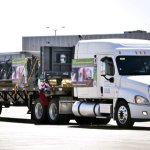
Mexican trucks such as these two are the targeted obsession of Teamsters, OOIDA and their allies whose lawsuit against allowing them legally required access has now been consolidated by the DC Court of Appeals

Today, the International Brotherhood of Teamsters responded to the FMCSA’s response to the Teamster’s frivolous lawsuit with a totally bizarre brief, full of spin and out and out lies. Nothing we haven’t come to expect from the opponents of Mexican trucks and of America fulfilling the promises we made to our southern neighbor.

The irrelevant little man who is President of Teamsters stated;

“The FMCSA makes the bizarre argument that our members aren’t harmed by a program that opens the border to low-paid truck drivers and dangerous, dirty trucks. Try telling that to our members.

U.S. commercial truck drivers must follow all U.S. safety regulations while Mexican drivers only need to follow selected Mexican regulations. The government is flat-out wrong to say Mexican trucks and drivers meet equivalent standards.”

So Hoffa begins his latest tirade with two well worn out lies, which have been totally debunked, proven false time and time again. Mexican trucks and their drivers MUST follow the same rules and regulations as US and Canadian drivers when operating in this country.

Dissecting the TEAMSTERS brief

The brief filed yesterday by the Teamsters doesn’t present any new arguments, instead reveals how the opponents of Mexican truck access are reduced to “grasping at straws” in their continuing failure to stop this legal obligation this country has under the rules of NAFTA.

In response to FMCSA’s claim that Teamsters and OOIDA do not have “standing” to file these actions in Federal Court, since they cannot prove “harm” to plaintiffs, TEAMSTERS have of course come up with TWO PEOPLE who have been IRREPARABLY HARMED, by the presence of an additional 3 Mexican drivers and 2 Mexican trucks in the US. The brief states;

Petitioners declarations establish that the safety of drivers and trucks disproportionatelyaffects IBT members, particularly members, such as declarants Deane Allen and Jack Cawood ,who drive in the west, southwest, and south – where much pilot-program activity will occur.

IBT members are not just any citizens, but those most likely to beharmed by highway safety problems

Opening Br. 19. Finally, FMCSA concedes that two IBT members have submitted declarations that “suggest injury or risk of injury” from pollution.

An IBT member whose asthma is aggravated by diesel exhaust from trucks regularly travels on a highway with significant trucking traffic from the border zone. Cawood Dec., ¶¶3, 8. He – and the many other IBT members who drive trucks in the west, southwest, and south (Kimball Dec., ¶7) – will be particularly harmed by the pollution the pilot program causes. That is enough to satisfy the requirement that NEPA petitioners show that they are “uniquely susceptible to injury.”

Petitioners have submitted detailed declarations from IBTmembers who live and drive in the area the pilot program will most affect and who are subject to the safety and environmental effects FMCSA has ignoredSo Mr. Caewood, a TEAMSTER, who has asthma, and who drives a diesel truck, would be “harmed” by the addition of a few more Mexican trucks on the nations highways?  We don’t think so!

The Teamsters brief erroneously claims the Federal Motor Carrier Safety Administration breaks the following laws:

  • It waives a law that trucks must display certain proof that they meet federal safety standards.
They are of course referring to the requirement to display a decal certifying compliance with Federal Motor Vehicle Safety Standards (“FMVSSs”). 49 U.S.C. §§30112(a), 30115(a). Considering these are the same types and brands of trucks US companies operate, and considering the fact that most of these trucks utilized by the Mexican carriers are purchased in the US, this argument is moot.
  • It breaks the law requiring the pilot program to achieve an equivalent level of safety because Mexican drivers don’t have to meet the same physical requirements as U.S. drivers.
This is perhaps the biggest stretch. Mexican medical standards require a driver to recognize only the color “RED” while US medical requirements require recognition of “RED, YELLOW and GREEN”, the colors present in STOP LIGHTS. However, Stoplights are the same in Mexico and the US and Canada. Furthermore, Mexico’s medical standards are much tougher than the US standards inasmuch as they include a disqualifiers such as a BMI in excess of 35 as an example. Again, the opposition is merely grasping at straws.
  • It breaks the law that Mexico must provide simultaneous and comparable access to U.S. trucks. Mexico cannot do so because of the limited availability of ultra-low sulfur diesel fuel in Mexico.
Teamsters are using this weak argument despite evidence to the contrary and they are assuming that US trucks would be in country to the point they would need to purchase Mexican fuel. ultra Low Sulphur Diesel is indeed widely available in the major metropolitan areas and the border region should US carriers need to purchase fuel in Mexico. However, with trucks averaging 6.5 miles per gallon and fuel capacity of 300 gallons, the need to purchase would not be there. Furthermore, nothing in NAFTA specifies this type of fuel be available and the FMCSA has no authority to demand it as a condition of participation in the program.
  • It breaks the law that the pilot program must include enough participants to be statistically valid. The FMCSA’s proposal ensures that only the best Mexican trucks participate, which would allow it to justify letting any Mexican truck over the border in the future.
The lies, delaying tactics, corrupt politicians in the pocket of the Teamsters and OOIDA, up to this point, have assured that there will not be enough participants to provide a “statistically valid sample”, however, with the program being in it’s first six months and FMCSA taking extra care in approving participants, this will most likely change when the Mexican carriers can see the potential for a return on their investment.  This is really an invalid argument until such a time as all interested carriers pass their PASA and are admitted to the program.
  • It doesn’t comply with the environment requirement of the National Environmental Policy Act.

Perhaps the weakest of their arguments and the most disingenuous, is this argument. The Supreme Court ruled in 2004 that FMCSA does not have reason to conduct these reviews, although they were later done as required by FMCSA. Simply because the results do not satisfy the opposition, does not mean that FMCSA is not in compliance with something they are not required to comply with.

It’s the same old shit, different day, that will eventually be tossed by the Appeals Court.

However, should they somehow prevail, then expect the LEGAL TARIFFS to come roaring back with a vengeance. We don’t think that will happen though seeing the lack of interest in this issue by Congress and the toady politicians in the pocket of the TEAMSTERS and OOIDA.

Oral arguments on this are tentatively scheduled for April 2012 and a decision could be coming in summer


What’s the problem with the Cross Border Pilot Program with Mexico?

Anna Amos, director of safety programs for the Federal Motor Carrier Safety Administration, left, and Marcelo Perez, a transportation safety investigator for the agency, addressed Mexican truckers in Tijuana on Friday. — Alfredo Ortíz

Anna Amos, director of safety programs for the Federal Motor Carrier Safety Administration, left, and Marcelo Perez, a transportation safety investigator for the agency, addressed Mexican truckers in Tijuana on Friday. —Photo – Alfredo Ortíz -SUT

The story in Friday’s edition of the San Diego Union Tribune brought to light the low level of participation in the Cross Border Pilot Program for Mexican carriers with the revelation that two officials from FMCSA were in Tijuana meeting with Mexican transportation stakeholders hoping to interest more Mexican carriers in participating in the program.

Part of the reason for the low level of participation in the program, according to Alfonso Esquér, Canacar’s representative in Tijuana is that the new program has far too many limitations.

According to CANACAR National President Juan Carlos Muñoz Márquez, “It is very complicated, it’s very expensive, and to tell you the truth, it hasn’t brought us any benefit.”

Transportes Olympics, the first carrier to participate and cross the border in the 2007 and 2011 program reportedly spent more than $10,000 to prepare for the first program.

Opponents of the program, Teamsters, OOIDA and so called bogus safety groups have preyed upon the fears, prejudice and ignorance of otherwise good solid American drivers, by convincing them that once the Mexicans are allowed in the United States, they’ll be in the unemployment line. A couple of hundred Mexican trucks are going to put 4 million US CDL holders out of business? Anyone believe that.

These opponents take it one step further, inciting hysteria among an ignorant populace that knows nothing about trucking, claiming that these “dangerous, unsafe Mexican trucks” driven by “untrained, unqualified, drug using Mexicans” will put the soccer moms families at risk. This is Teamsters President James P. Hoffa’s favorite rant, although it couldn’t be further from the truth.

And Mexican truckers do not operate as we do in the US. Most US carriers are out to haul freight on irregular routes. Mexican carriers operate under contract. Generally, they go out with a load and return to their domiciles with another load. Without established contracts with their customers in Mexico for a back haul into Mexico, or contracts in this country for the back haul, there is little benefit.

Opponents of Mexican Trucks use innacurate government data to press their case

CSA (Comprehensive Safety Accountability) the FMCSA’s new compliance measurement system for companies operating in the U.S, that replaced the old SAFERSYS database is responsible for inaccurate portraits of carrier performance and is being used by opponents of Mexican trucks, to paint a portrait of the carriers that is far from accurate.

Senior Editor Jami Jones of Landline Magazine, once a very competent journalist before becoming involved in the Mexican truck debate, posted a story yesterday based on the San Diego Union-Tribune report. And as usual, she puts a spin on it that reflects OOIDA’s policy of misinform, circumvent the truth and when necessary, lie about the Mexican trucking industry.

Jones writes:

For example, applying companies Servicio De Transporte International, Trinity Industries, Maria Isabel Mendivil, Luis Edmundo Grijalva Gamez, Transportes Unimex and Autotransportes Libre Comercio are all in alert status in the Driver Fitness BASIC. That BASIC tracks compliance issues in licensing, ability to read and speak English sufficiently, current medical certification, etc. All six of the motor carriers have a BASIC score of 99 percent or higher.

This is a prime example of what she fails to point out.Servicio de Transporte International based out Cd. Juarez, Chih, across the border from El Paso Texas, does indeed have a DRIVER FITNESS BASIC of 100%. On the surface, this appears bad. But what have the drivers been found in violation of?

The majority (1243) not being able to speak English to the satisfaction of the inspecting officer! This company is a commercial zone carrier and most would admit that 391.11(b)(2) is arbitrary and capricious inasmuch at it gives no guidance as to what is “competency” in the English language.

This same carrier shows in the FATIGUED DRIVER BASIC, 35 violations, out of 8,465 inspections of drivers not having log books. Log books are generally not required when operating within a 100 air mile radius of your home terminal which you return to each night, as these guys do.

And in the VEHICLE MAINTENANCE BASIC, the majority of violations are a Texas DPS specialty. 393.45(b)(2) Failing to secure brake hose/tubing against mechanical damage. 2434 violations. A trooper thumb against the airline leaves “evidence” of “chafing”. This is closely followed by 1043 incidents of a light out. It might only be a marker light, but that’s enough in this new age of CSA.

It’s happening to the Mexicans, the Canadians and our drivers.

Jones continues with her spin by informing that;

Two other motor carriers – one of which is Grupo (Behr) – have safety rankings in CSA. Grupo still maintains a 50.5 percent in the Vehicle Maintenance BASIC. GCC Transporte has scores of 47 percent and 57 percent in the Driver Fitness and Vehicle Maintenance BASIC respectively.

What Jones is insinuating is that these carriers are baaaddd having what would appear to be “high” percentiles in the various basics. However, the intervention thresholds for the various BASICS, meaning when FMCSA would take a look and send a warning letter, is

  • UNSAFE DRIVING     60%
  • FATIGUED DRIVING  60%
  • DRIVER FITNESS       75%
  • DRUGS/ALCOHOL      75%
  • VEH. MAINT.               75%
  • CARGO RELATED       75%
  • CRASH                         75%
So the insinuation is that these carriers have a poor safety history is totally bogus when in reality, they are quite safe.
And the company we chose to illustrate our point, .Servicio de Transporte International of Cd. Juarez. In the 24 month reporting period, only one accident. 8480 total inspections with an OOS rate of 8% for vehicles and 1% for drivers. For below the national average in the US of 20.72% and 5.51% respectively.
So far now, another reason for Mexican carriers to be skeptical about participating in a program that is not required under NAFTA.
And we can continue to expect the opponents such as OOIDA with their lies and misinformation to mislead the American trucker and the public at large and of course Teamsters President James P. Hoffa who recently claimed in a totally bogus story in HuffPost that;
Mexico’s failure is especially egregious in the case of cross-border trucking. U.S. trucks and truckers have to meet much more rigorous safety standards than their Mexican counterparts. Carnage and crime prevent them from using Mexican highways. But Mexican trucks that don’t meet U.S. safety standards are allowed to drive on violence-free U.S. highways as part of the U.S. Transportation Department’s latest pilot program……..
Further proof that FMCSA is indifferent to highway safety came with the second company allowed into the pilot program. Transportes Olympic has one truck with a 33 percent out-of-service rate.
Apparently Hoffa is continuing to show his ignorance. Transportes Olympic has a 14% Out of Service rate based on FMCSA’s CSA database for a “light out”. This from 11 inspections on 1 truck since the program started.
As Marcelo Perez, the  transportation safety investigator for FMCSA said during last Fridays meeting,
When the previous pilot project was suspended in 2009, “no one was able to say that Mexican carriers are any less safe than U.S. carriers. The only thing they could say was that the project did not have sufficient data to come up with a statistically valid decision. That’s where we find ourselves today, needing you to participate in this program so that we don’t come up with another draw.”
Personally, we don’t see the need for any type of cross border program as Mexican carriers have historically been and continue to be as safe, if not safer than their US and Canadian counterparts.


For the time being, Mexican carriers see “no benefit” of participating in the cross border pilot program

In a meeting in Tijuana B.C this past Friday, Anna Amos, director of safety programs for the FMCSA, and Marcelo Perez, a transportation safety investigator for the agency, expressed concern over the low level of participation by Mexico-domiciled carriers, saying their enrollment is critical to the success of the three-year project.

During the meeting, Amos and Perez suggested that without significantly more Mexican involvement, the U.S. Department of Transportation won’t have enough data to show that Mexican trucks can operate safety outside the commercial trade zone.

Considering that Mexican carriers have been operating in the US for decades, being grandfathered in after Reagan signed the 1982 Foreign Carrier Exclusion order, FMCSA should have substantial and significant data  to make this decision.

The objective of the Cross Border Pilot program with Mexico, supposedly is to collect and evaluate data on the safety performance of Mexico-domiciled carriers.

That data would then be evaluated to determine whether the program should be made permanent.

FMCSA has a three-year target of 4,100 inspections. The agency said it would take about 46 Mexico-domiciled participating carriers to reach that target.

Data obtained during the 2007 Cross Border Demonstration program showed Mexican carriers to be as safe, and in most cases, safer, than their US and Canadian counterparts.

[pullquote]“The new program has way too many limitations, and that’s possibly why there aren’t enough carriers” that have registered - Alfonso Esquér CANCAR Tijuana[/pullquote]

Twenty-two Mexico-domiciled carriers have now applied to participate in the cross-border demonstration project.

State of the state of the Cross Border Pilot Program

According to THE TRUCKER,

As of Monday, only two carriers have operating authority to participate in the pilot program.

Five other carriers are awaiting the result of their Pre-Authorization Safety Audit (PASA).

Another, Grupo Behr, passed the PASA, but concerns about the carrier’s safety record during the public comment period resulted in FMCSA not granting operating authority pending further investigation.

Nine more Mexico-domiciled carriers whose names do not appear on the last operational report have completed applications and are being moved the PASA phase, an FMCSA spokesperson said Monday. Five other carriers have submitted applications, but those five applications were considered incomplete. The FMCSA is waiting for those carriers to return complete applications before moving them on to the PASA process.

During its Grupo Behr investigation, FMCSA discovered violations involving the carrier leasing its vehicles to a company with authority to operate beyond the commercial zones, something not allowed under U.S. law, an FMCSA spokesperson said.  FMCSA issued a Notice of Violation to the company. Grupo Behr has submitted a corrective action plan, and FMCSA intends to monitor the company’s operations for six months and reconsider its application for the program at that point.

FMCSA operational reports on the program are complete through Feb. 5, 2010.

The data shows that there have been nine northbound border crossings.

There have been seven inspections, one of which resulted in a Transportes Olympic vehicle being placed out-of-service Jan. 2 for an inoperable required lamp.

The carrier corrected the problem on site and the vehicle was cleared to resume its trip.

[pullquote]“It is very complicated, it’s very expensive, and to tell you the truth, it hasn’t brought us any benefit.” – Juan Carlos Muñoz Márquez, CANACAR National President[/pullquote]

Members of the Mexican carrier community and CANACAR, Mexico’s trucking association have long complained that Mexican carriers are being forced to adhere to much stricter standards than their US and Canadian counterparts, a claim readily evidenced by the PASA, which Canadians do not have to undergo and which is not a part of the NAFTA truck agreement. This is evident when by the a truck being put “out of service” for a light being out. At best, a US or Canadian trucker would receive a warning or a “fix-it” ticket and that would be that.

Perhaps once the D.C. Court of Appeals throws out the frivolous lawsuits filed by OOIDA and the Teamsters, maybe the confidence level in the Mexican carrier community will be high enough to overcome this issue.

Witch hunt against Mexican carrier by OOIDA returns minor violation of leasing regs.

Grupo Behr

Outside his company’s warehouse in Otay Mesa, truck driver Jorge Villanueva inspected his 24-foot GMC on Wednesday. The bobtail box-truck is operated by Tijuana-based Grupo Behr, which has applied to participate in a pilot program that allows Mexican truckers to make deliveries across the United States. / Photo by Nelvin C. Cepeda * U-T

Grupo Behr, the Mexican carrier who was the first victim of OOIDA’s campaign of propaganda and misinformation, has allegedly been found to be in violation of  leasing statutes in Section 219 of the 1999 Motor Carrier Safety Improvement Act, according to William Quade assistant administrator for FMCSA’s  Enforcement and Compliance division.

Section 219 of the 1999 Motor Carrier Safety Improvement Act was intended to end the ability for a Mexican carrier to lease trucks and drivers to a U.S.carrier for operations beyond the authority the Mexican carrier could get clearance for on its own. That ability was for commercial zone authority commonly referred to as OP-2 authority.

FMCSA  issued a notice to Grupo Behr, whose headquarters are in Tijuana Baja California for violating Section 219, but FMCSA chose  not to  pursue civil penalties. “Our preliminary decision is to monitor the situation for six months to consider whether we should allow them into the program,” Quade added.

Grupo Behr successfully completed their PASA last year but approval to participate in the program was put on hold after  OOIDA erroneously claimed that Grupo Behr would be operating pre- 1995 semi’s and straight truck in the project.

MTO spoke to a representative of Grupo Behr who said that critics’ accusations about lax safety standards are unfounded and erroneous.

Roberto García de León, managing partner of Grupo Behr said, “They’re accusing us about vehicles that we haven’t even enrolled in the program,”  a fact MTO uncovered  shortly after OOIDA made their outrageous and totally false claims again GB.

Grupo Behr also participated in the 2007 pilot program successfully. Currently, under CSA, their SMS scores are consistent or slightly below the US national average. 21% out of service for equipment and 3% OOS for drivers.


Teamsters expand “frivolous” lawsuit against Mexican truck program

"Someone oughtta shoot that motherf*&#er! Let 'im organize the dead!" – Jimmy R. Hoffa (referring to his sons delusional opposition to Mexican trucks?)

Jimmy R. Hoffa (1913-1982), legendary leader of the Teamsters must be looking up from from the great beyond, shaking his head in disgust at the pathetic loser that bears his name, James P. Hoffa. Hoffa, re-elected by a minority of the Teamsters (Hoffa received 137,172 votes out of a membership of 1.4 million) rank and file to guide the once powerful International Brotherhood of Teamsters into further mediocrity, has chosen to hasten their descent by expanding their frivolous lawsuit against Mexican trucks.

Teaming up with so called “public interest” group PUBLIC CITIZEN and tree huggers SIERRA CLUB, they’ve expanded their frivolous and merit-less lawsuit filed back in September which failed to halt the implementation of the new cross border pilot program with Mexico.

“Opening the border to these dangerous, dirty trucks is an attack on highway safety, an attack on American truckers and warehouse workers, an attack on border security and an attack on our environment,” said the delusional little man, James Hoffa. “It’s outrageous enough that we’ve outsourced millions of jobs to foreign countries, but now we’re bringing foreign workers across the border into the United States to take our jobs. This is another pressure the American middle class doesn’t need.”

Hoffa and his cohorts are using the same baseless arguments as OOIDA did in a similar lawsuit filed in September in which a Federal Court denied OOIDA an injunction to stop the program, although allowing the suit to be fast tracked.

The Teamsters suit claims the Federal Motor Carrier Safety Administration breaks the following laws:

  • It waives a law that trucks must display certain proof that they meet federal safety standards.

(Not true. The pilot program requires trucks participating to be 1998 or newer and compliant to US EPA laws in effect at time of manufacture. An EPA sticker or declaration of compliance is required)

  • It breaks the law requiring the pilot program to achieve an equivalent level of safety because Mexican drivers don’t have to meet the same physical requirements as U.S. drivers.

(Medical requirements for Mexican drivers are more stringent than those for US drivers. The basis of this claim is Mexico only requires vision acuity of the color red, while the US requires Red, Yellow, Green, acuity. A minor difference)

  • It breaks the law that Mexico must provide simultaneous and comparable access to U.S. trucks. Mexico cannot do so because of the limited availability of ultra-low sulfur diesel fuel in Mexico.

(NAFTA truck access rules require “equal access” for all three countries to one another. The ULSD claim is bogus as ULSD is widely available in border cities and major metropolitan areas in Mexico.)

  • It breaks the law that the pilot program must include enough participants to be statistically valid. The FMCSA’s proposal ensures that only the best Mexican trucks participate, which would allow it to justify letting any Mexican truck over the border in the future.

(Another bogus argument and because of this, Mexican carriers are hesitant to commit the money and other resources necessary to participate in the program until they are assured these bogus claims and lawsuits are a thing of the past.)

They also make the claim that FMCSA has not made the required Environmental Impact Assessment, which is patently false.

This is just more chest pounding and posturing by this irrelevant little media whore. Case law prevails on the environmental issue.

In 2002, Public Citizen sued the FMCSA claiming an environmental impact study was required before any effort could be made to open the southern border to Mexican trucks as required under our NAFTA obligations.

At that time, FMCSA prepared an Environmental Assessment (EA), but they did not prepare and Environmental Impact Statement (EIS) as PUBLIC CITIZEN claimed was required by the National Environmental Protection Act (NEPA).

The EA focused mainly on the environmental impact from doing more inspections, not on the impact from more trucks driving the roads.

Public Citizen sued to stop the possibility of cross border trucking until an EIS was prepared.Public Citizen argued that the increased number of trucks on US roads was liable to have a significant environmental impact, and therefore an EIS was required. There claim was that more than 30,000 older polluting trucks burning high sulphur diesel would have an impact on our environment.

The trial court found in favor of the defendent, FMCSA. The Trial Court found that although the FMCSA pilot program would result in more trucks, FMCSA did not have control over those trucks and therefore did not have to account for them in an EIS. Public Citizen went shopping and appealed to the liberal Ninth Circuit Court of Appeals in San Francisco.

The Ninth Circuit ruled in favor of the plaintiffs, reversing the trial court. The Appellate Court found that the EA was deficient because it failed to give adequate consideration to the overall environmental impact from the Mexican trucks. Of course, FMCSA appealed, all the way to the United States Supreme Court.

The case was argued before the Supreme Court on April 21, 2004 with a unanimous verdict being rendered on June 7, 2004.

The US Supreme Court held that the FMCSA had no control of the trucks once the regulations governing the pilot program were passed, and would therefore be unable to act on the findings of an EIS even if it did conduct one.
FMCSA has no statutory authority to impose or enforce emissions controls or to establish environmental requirements unrelated to motor carrier safety.

The Court also found that the passage of the regulations was not sufficiently responsible for the increased pollution caused by the trucks to warrant an EIS.

Justice Clarence Thomas, the Courts most conservative Judge wrote the opinion which you can read here.

All other arguments seem to be without merit and simply a manner for the opposition to keep pressure on the Mexicans not to participate in the program, due to the uncertainty of it’s future.

Teamsters talk about job losses which will not occur yet they ignore the 25,000 private sector jobs lost due to the legal retaliatory tariffs Mexico imposed over our refusal to comply with our NAFTA obligations.

They choose to ignore also, that Mexico reserves the right, to re-apply the tariffs if in the slim chance, Hoffa, OOIDA, through their puppet Congress critters, is somehow able to put an end to the program. We see this newest attempt as going now where in the end.

And the delusional little man leading the Teamsters will push that once proud organization into further irrelevance, the same as Todd Spencer and Jim Johnston are doing with OOIDA in their opposition to this program.

Thinking back, Jimmy Hoffa was a corrupt but brutally honest man who kept his word. Damned shame his son is just the opposite.

Mexican Cross Border Pilot Program officially underway as first Mexican truck arrives at Laredo

2009 Freightliner Cascadia, Transportes Olympic #76

Josue Cruz, a driver for Transportes Olympic inaugurated the new Mexico Cross Border Pilot Program when he arrived in Laredo today on his first trip to Garland Texas

An editorial caught me eye this morning, on this day that the first Mexican carrier to be granted authority to operate beyond the commercial zone enters the U.S. It reads in part;

When a nation signs and ratifies a treaty with another, it is in effect a contract between those countries.

And when one country later simply decides it does not like the terms of the treaty and unilaterally decides to stop abiding by those terms —- well, that nation isn’t behaving very honorably, is it?

The roadblocks being thrown up by groups like OOIDA and the Teamsters that have prevented the United States from honoring their contract is nothing short of dishonorable.

Today changes that as a truck belonging to Transportes Olympics of Apodaca Nuevo Leon and driven by  Joshua Cruz, 29 and a father of three from the Monterrey area. Cruz, who has been driving for Transportes Olympic since March has more than 10 years experience behind the wheel.

[pullquote]“I consider my  fleet’s access to the U.S. interior like being invited to a friend’s house. ”We have to be extra orderly and very respectful. We will demonstrate that we can operate safely and efficiently.” Fernando Paez Trevino [/pullquote]

Cruz, driving a 2009 Freightliner Cascadia, unit number 76 will be pulling flatbed with a 30 foot drilling tower to Garland Texas for a 0700 delivery appointment on Saturday with Atlas Copco Drilling Solutions, which specializes in the manufacturing and marketing of equipment used in drilling and exploration industries such as oil, water, mining, among others. The tower originated from  INMAGUSA in Monclova Coahuilla and arrived on Transportes Olympics Apodaca terminal yesterday.

After leaving Apodaca this morning, Cruz arrived at Bridge #3 in Laredo to plenty of fanfare and celebration. Greeting Cruz as he began the inspection process that all of the participants must undergo each time they cross the border, was the Secretaries of Economy and Transport and Communications, Bruno Ferrari and Dionisio Perez-Jacome, respectively, the U.S. ambassador in Mexico, Anthony Wayne, and the governor of Tamaulipas, Egidio Torre Cantú.

“With this program, we’re initiating a new stage of competition, of prosperity, of regional integration,” said Bruno Ferrari, Mexican secretary of the economy.

U.S. Ambassador Anthony Wayne said governments “have to support the businesses in their efforts to reduce costs and accelerate trade.”


Following the Level I CVSA inspection by personnel from the FMCSA and Texas DPS, something not required of the Canadians when they enter the country, Cruz will proceed up I-35 to his destination in Garland Texas.

Hours before today’s  ceremony in the border city of Nuevo Laredo, Mexico announced it was suspending the tariffs. But the Mexican government warned that they would be reinstated if the U.S. does not honor the accord.

Transportes Olympic, a wholly owned Mexican company established in 1999 was also the first carrier authorized to cross during the successful 2007 demonstration project, which was defunded by Congress under threats from the Teamsters and others.

Transportes Olympics successful participation in the previous program gives them a “fast track” to permanent operating authority under the rules of the current program, something they have certainly earned and deserve.

So now we sit back and observe as this program commences and once again the Mexican carriers who are approved show once again that they are more than capable of operating in this country, complying with our rules and regulations and conducting themselves in a safe and professional manner as they have in the past.

Juan Carlos Munoz, president of Mexico’s largest trucking trade group, known by its Spanish initials as CANACAR, noted that opposition remains in Mexico. Some Mexican trucking companies doubt that the U.S. will treat them the same as American drivers.

“But we can’t cry before they hit us, as we say here in Mexico,” Munoz said. He called Friday’s activity the “first step on a long climb.

We’ll also sit back and chuckle a little at each impotent attempt to demonize the program and it’s participants as is continuing by the Teamsters and OOIDA and their allies in Congress.

And indeed it is impotent attempts as acknowledged by Rep. Peter DeFazio (D-OR) who acknowledged yesterday that he was losing the fight to stop this legal obligation of ours. DeFazio has had no success in getting his HB-2407 bill out of committee that would limit this to a pilot program. He acknowledges that he has little chance of getting an amendment into a continuing appropriations bill. Indeed, 9 out of 10 calls to Congress have been in support of the program.

And should by some strange twist of fate, the opponents succeed in once again delaying, defunding or causing the program to be suspended or scrapped, Mexico stands ready to bring the tariffs back with a vengeance, as they have every right to do.

Get used to it people! These well managed, closely monitored Mexican carriers are here to stay. Instead of beating your heads against the wall, making empty threats against the drivers, perhaps we should be looking at ways to profits from their presence. After all, Mexican trucks are nothing new to American roadways. They’ve been allowed for more than 60 years. You haven’t realized this because the Mexicans rarely do anything that brings attention to them. In other words, they operate in a safe professional manner under the same rules as US drivers and the 37,000 Canadian trucks that enjoy full access to the US with little oversight.

The Border is now open to long haul Mexican carriers – And the sky ain’t fallen yet!

FMCSA Inspector and Transportes Olympic

An FMCSA inspector conducts a Level I compliance inspection on a truck belonging to Transportes Olympic in 2007 prior to the initiation of the successful Mexican Pilot Truck Program

With the issuance of provisional operating authority to Transportes Olympics on Friday, October 14, 2011, our southern border is now open to long haul trucks from Mexico who have passed the requirements for participation in the pilot program.

This puts the US into long overdue compliance with our obligations under NAFTA. The remaining 50% of the$2.4 billion in legal retaliatory tariff’s Mexico placed on 99 US manufactured exports, will now be lifted within 5 days.

[pullquote]“Issuance of operating authority to Transportes Olympic is a positive step taken by the United States to come into full compliance with its commitments on long haul cross-border trucking services under the North American Free Trade Agreement (NAFTA),” said Ricardo Alday of the Mexican Embassy in Washington DC.[/pullquote]

“This is a big win for American farmers and consumers, who will no longer have to struggle with onerous tariffs imposed by Mexico,” said U.S. Transportation Secretary Ray LaHood.

Currently Mexico and America benefit from a $400 billion annual trade relationship and 70 percent of this trade is delivered by long-haul trucking companies.

But all is not copacetic, at least with Rep. Peter DeFazio, Congressman from Oregon’s 6th District and long in the pockets of the Teamsters and OOIDA.

DeFazio late Friday continued to spew the vitriol and lies that have long marked his objection to Mexican trucks at the behest of his handlers.

DeFazio referred to the issue as the  “so-called pilot program for cross-border trucking,” saying the program allowed Mexican trucks to operate in the U.S. even though Mexican trucking lacks basic safety standards, even though there is a multitude of evidence suggesting otherwise.

DeFazio went on to rant, “ I will continue to push my legislation that would forbid this kind of expenditure from the Trust Fund.  Until that happens, we will remain hostage to provisions that opened the door for this ill-conceived cross-border trucking program, and expose yet another American industry to lost jobs, and I continue. to question the legal authority of DOT to implement a permanent program.

DeFazio is of course referring to his bill HR-2407 which is stalled in committee which would limit the pilot program to a maximum of 3 years.